
Ciecierzyn: Church and Manor History
Accommodation in Ciecierzyn
Ciecierzyn brings together a Neo-Gothic church and the history of a park and manor complex. For travellers interested in architectural history and historic landscapes, these are two distinct themes. The individual dates tell of different periods: from a chapel endowed in the 18th century, through the 19th-century manor complex, to the church of 1878. At the municipal level, the focus also extends to Byczyna, whose historic townscape has its own distinct character.
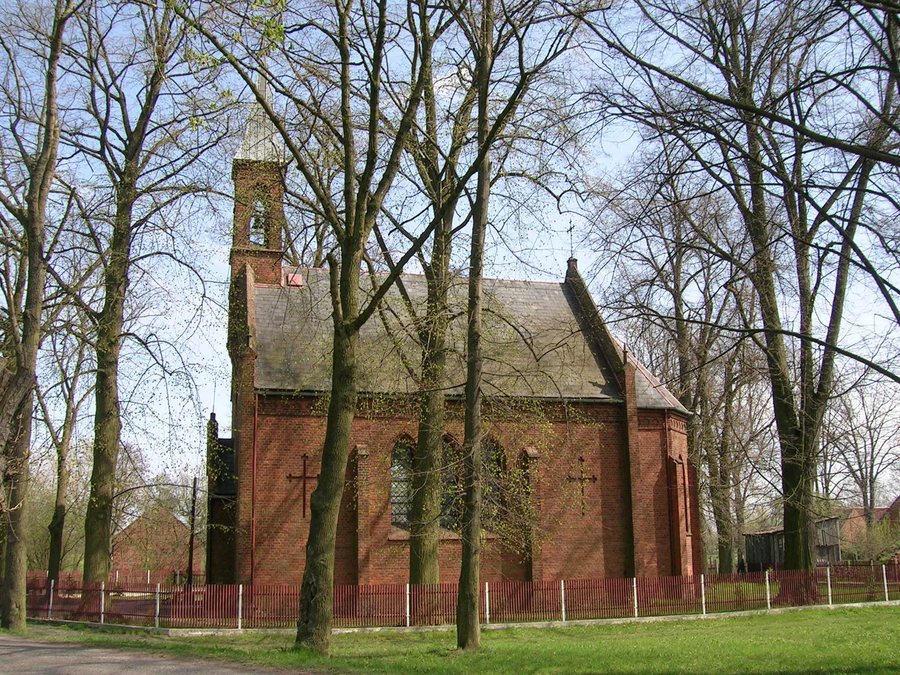 File:Kościół św. Stanisława Kostki w Ciecierzynie.jpg
Photo: gmina Byczyna via Wikimedia Commons, CC BY-SA 4.0
File:Kościół św. Stanisława Kostki w Ciecierzynie.jpg
Photo: gmina Byczyna via Wikimedia Commons, CC BY-SA 4.0
The filial church of St Stanislaus Kostka
The village is home to a brick, Neo-Gothic filial church of St Stanislaus Kostka, dating from 1878. Its architectural style and dedication provide a clear religious landmark in the history of the village. Together with the manor and park complex, it shows that Ciecierzyn’s architectural heritage is shaped by more than one historical context. Visitors choosing places for their architecture and history can consider the church as a chapter in its own right alongside the development of the manor complex.
Park and manor complex: residential and agricultural areas
The park and manor complex was established in the mid-19th century. Its surviving elements reveal a division between a residential area and an agricultural section. Remains of the residential area survive; the agricultural section includes a farmyard and a former workers’ housing settlement. The complex therefore cannot be understood solely through a grand residence: farm operations and the workers’ homes are also part of its history.
The palace on the estate was built in 1880 through the endowment of Artur von Prittwitz-Gaffron and was destroyed in 1945. A former manor chapel dedicated to the Exaltation of the Holy Cross is also part of this history: it was endowed in 1796 and was already a ruin in the 1960s.
Manor park: trees and location
The manor park lies in the west of Ciecierzyn. Deciduous trees predominate, with trees aged 140 to 160 years making up the largest share. These old trees shape the park’s landscape character and provide a different emphasis from the architectural history of the church and manor farm. The park also has a partly preserved driveway to the former manor farm and walking paths. The grounds are neglected; the condition of the paths may change.
The location of the park and manor complex offers another point of reference: its south side borders the paved road between Kostów and Gołkowice.
Byczyna and its historic townscape
The municipality also includes the town of Byczyna. Its historic character is shaped by a medieval town centre, town walls, defensive towers, and 18th-century townhouses. The town walls have a circumference of 950 metres and are up to six metres high. Remains of the town moat survive along the north side of the fortifications. Within the municipality, Byczyna thus offers an urban complement to Ciecierzyn’s church and manor themes.
Byczyna Town Hall houses a local history room and a viewing point in the town hall tower, with views over the town. If you plan to visit, check the opening arrangements in advance. The two destinations have clearly distinct themes: Ciecierzyn is known for its church, park, and manor history; Byczyna adds fortifications and historic urban architecture to the municipal context.
For the broader travel overview: Gołkowice.

