
Discover Uzdowo: Grunwald history and hiking trail
Accommodation in Uzdowo
Uzdowo offers two distinct starting points for planning your trip: the history of the Grunwald Monument and the proposed route of the Grunwald hiking trail. One leads to a clearly dated historical event, while the other places Uzdowo within a longer succession of hiking destinations. This lets you decide whether you are more interested in local history or would like to view Uzdowo in the context of a hiking route.
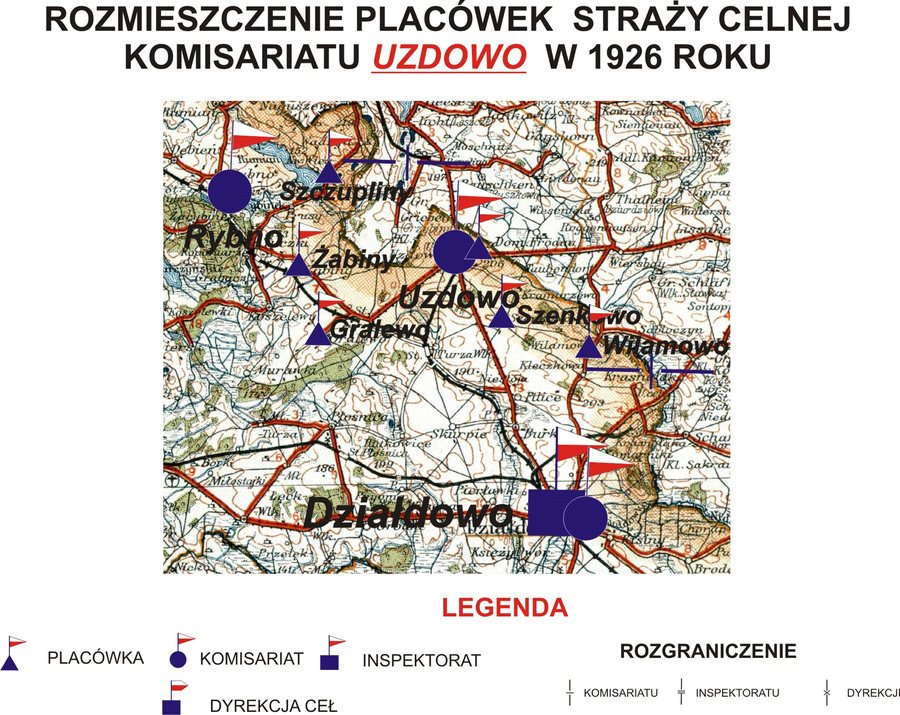 File:Uzdowo komisariat SC 1926.jpg
Photo: WIG,Ar. 44 - 1933; Mapa ze znakami SC - Gruzin via Wikimedia Commons, Public domain
The Grunwald Monument and its history
The Grunwald Monument in Uzdowo was erected in 1931. In the first days of the Second World War, in 1939, the Germans blew up the monument. The dates clearly distinguish its construction from its destruction: it was built before the war, while its demolition took place at the beginning of the war. Anyone exploring Uzdowo’s history will find a specific historical turning point that can be placed precisely in time.
Uzdowo on the proposed Grunwald hiking trail
The Grunwald hiking trail is a red-marked route prepared by the Warmińsko–Mazurski Oddział PTTK. The proposed sequence includes Grunwald, Leszcz, Grzybiny, Uzdowo, Myślęta, Turza Wielka, Skurpie, Wysoka, Prioma, Płośnica, Turza Mała, Koty, Jeleń, Wąpiersk, Ciechanówko, Chełsty, Kurojady, Lidzbark, Bryńsk and Bądzyn. Uzdowo is therefore one of several named places along the route. Before setting out on a specific hike, it is worth checking the current route and trail conditions.
Działdowo within the broader destination of Soldau
In Działdowo, the Interactive Museum of the Teutonic State opened in the town hall on 13 August 2013. The Interactive Exhibition of the Teutonic State occupies two levels; the first consists of five rooms arranged chronologically. These details offer two perspectives for exploring the exhibition: its overall layout and the chronological organization of the first level.
The Muzeum Pogranicza is a municipal cultural institution housed in Dom Duży, which was rebuilt and adapted for cultural purposes. Its permanent exhibition is titled “Działdowo – miasto i ludzie dawnego pogranicza”. The town itself also offers a sense of its history: the Old Town retains its original medieval street layout, and a square marketplace lies at its center. The town hall in the center of the marketplace dates from 1796. The street layout and the shape of the square convey different aspects of the town’s structure.
The Sanctuary of the Blessed Martyrs of Działdowo is located in the Church of Saint Catherine of Alexandria. It commemorates Archbishop Antoni Julian Nowowiejski and Bishop Leon Wetmański, who were martyrs of the camp in Działdowo. The former barracks building in Działdowo is also of particular historical significance and is considered a testament to the martyrdom of the Polish nation. Another chapter in the town’s history is represented by the Teutonic Castle, which is part of the “Szlak Zamków Gotyckich”, the Trail of Gothic Castles.
For more cultural experiences, there is the Działdowski Jarmark, featuring antiques, crafts and healthy food. It is a recurring gathering celebrating culture, craftsmanship and local creativity. Park Honorowych Dawców Krwi has walking paths, a high ropes course, outdoor trampolines and a stage. This means Działdowo offers a range of topics, from the history of the town and its museums to market life and parks.
Discover more destinations
Discover more destinations: Kopaniarze, Nowa Wies, Murawki, Lidzbark, Grądy, Działdowo, Rybno, Naguszewo
Return to the broader travel overview: Soldau.

