
Discover Ugoszcz: churches and a cycling route
Accommodation in Ugoszcz
Ugoszcz, in the Gmina Studzienice, can be explored through its churches and a cycling route between Ugoszcz and Czarna Dąbrowa. This gives the village two different points of interest for your trip to Poland: historic architectural and decorative details, and a specific route length to help you plan a cycling trip. If you are looking for a holiday apartment, you can assess whether Ugoszcz suits your interests and check whether these topics fit your stay.
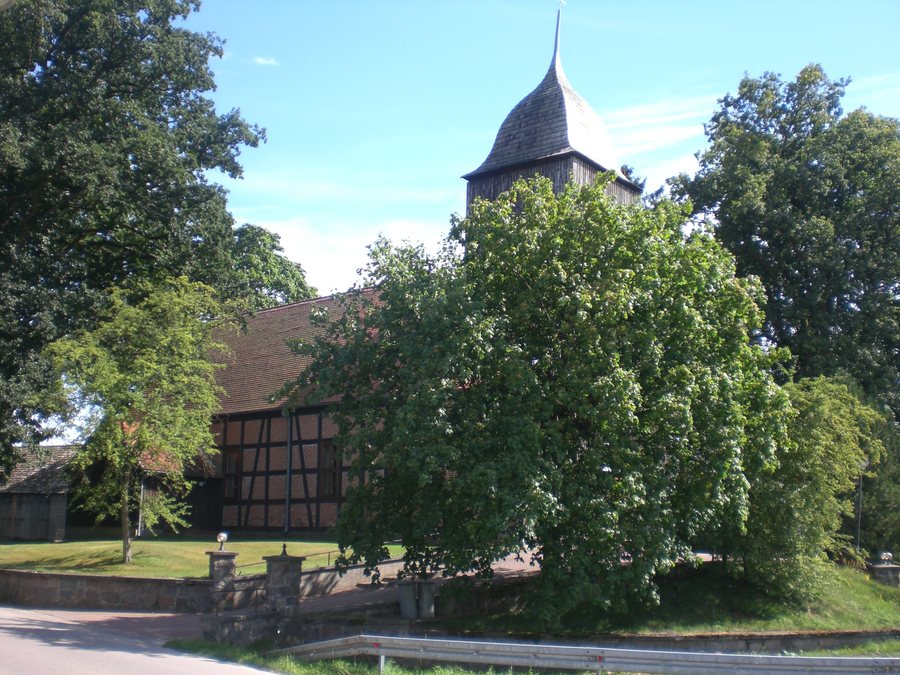
Two churches from different periods
The Church of St. Mary Magdalene was built in 1822; the Church of Our Lady of the Scapular was built in 1897. These two dates offer a simple chronological comparison without equating the churches: they point to different building periods in Ugoszcz. If you are interested in the history of a place, you can first distinguish between the building histories of the individual churches and then take a closer look at the distinctive details of St. Mary Magdalene.
Half-timbering and architectural form of St. Mary Magdalene
The Church of St. Mary Magdalene stands on a small hill. It is an east-facing half-timbered church with brick infill and a stone foundation. Its floor plan is rectangular, with the chancel on the east side. These features describe not just individual building elements; they also give you several specific details to look for when exploring the building: the half-timbered construction, the brick infill between the beams, the transition to the stone foundation, and the position of the chancel. The church’s location on the hill is also part of its historical description.
Rococo high altar and side altars
The furnishings of St. Mary Magdalene also bring together works from different periods. The high altar is a Rococo altar from the second half of the 18th century. The painting it contains depicts the Madonna and Child; it was painted by T. Render in 1868. There are also two side altars from the second half of the 18th century, designed in the folk Baroque style. Comparing the high altar with the side altars makes the different style designations within the same church tangible. The altars can also be distinguished chronologically from the painting, which was created later: the altar construction and the painting do not belong to the same period. For travellers interested in ecclesiastical architecture and furnishings, these are specific subjects that can help place the church in context.
An oval village layout that can be reconstructed
Ugoszcz is one of the villages established in the Middle Ages whose oval layout can still be reconstructed, even though it has been greatly obscured and altered. This settlement pattern adds an older layer to the church architecture when looking at the village: not only individual buildings, but also the historic layout of the village offers a way to explore Ugoszcz. It is important to distinguish between the fact that the layout can be reconstructed and the fact that its original form has been greatly altered.
Cycling route between Ugoszcz and Czarna Dąbrowa
The Ugoszcz–Czarna Dąbrowa cycling route is 7.0 km long. If you are considering the route for an outing, you can compare its length with your other plans; check the route conditions before setting out. Ugoszcz thus offers a clearly defined cycling attraction alongside its churches and their architectural and decorative details, appealing to different interests when choosing a place to visit.
Discover more destinations: Kołczygłówki, Borzytuchom, Parchowo, Frydrychowo, Tuchomie, Bytów, Wojsk, Świeszynko.
For the broader travel overview: Bytów.

.jpg)