
Żukowice on the Oder: Church, Palace and Archaeology
Accommodation in Żukowice
Żukowice lies on the left bank of the Oder, 7 km from Głogów (Glogau). The village offers a clear historical focus when choosing a destination: church architecture, palace history and archaeological traces sit alongside its location on the Oder. If you enjoy immersing yourself in a place’s history, you’ll find a range of periods and topics here rather than just a single historical point of interest.
Church and historic furnishings
The Church of St. Hedwig in Żukowice is mentioned as early as 1376 in a church register. The church in Żukowice is a single-nave brick building, constructed between 1585 and 1587. Its barrel vault with lunettes and its Renaissance and Baroque furnishings offer two distinct architectural points of interest. The oldest furnishing is a sandstone baptismal font dating from around the turn of the 13th and 14th centuries. Numerous tomb slabs are associated with noble families from Żukowice and Glinica. In this way, different forms of historical remembrance come together: the construction, furnishings and family histories associated with the tomb slabs.
Palace history and landscaped grounds
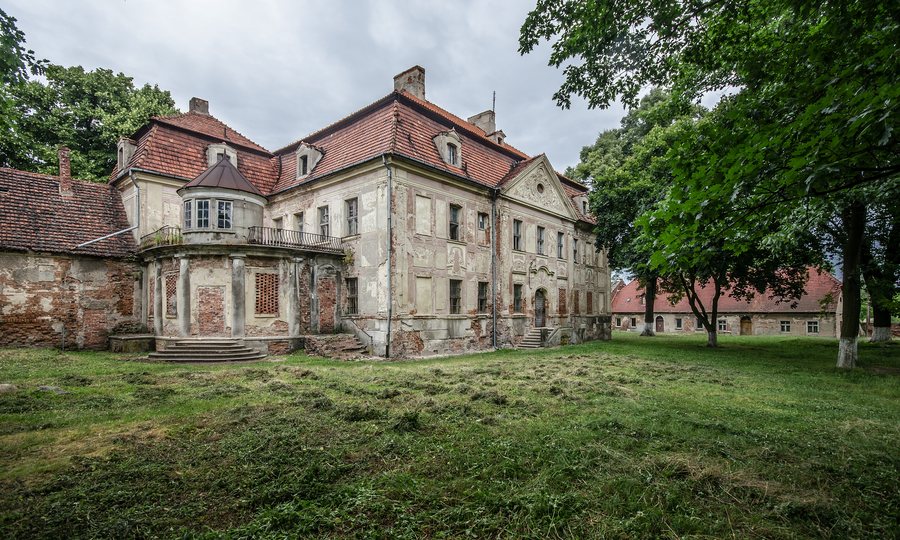
The palace’s history can also be traced through specific dates. In 1740, Frederick II stayed at the palace in Żukowice Dolne during the Austro-Prussian War. The palace was destroyed in 1760 and rebuilt in 1763. Thus, both a historic wartime visit and the palace’s destruction and reconstruction are part of its history. These events add another perspective on the village’s past to the older history of its church and furnishings.
A preserved section of the landscaped park at the palace dates from the late 18th century. Żukowice also has a garden from the same period. These green traces of history broaden the focus beyond buildings: landscaped grounds are also part of the village’s history. For those interested in cultural history, this offers another aspect to consider when exploring Żukowice.
Archaeological traces around Żukowice
The archaeological history reaches far back before the periods of the church and palace. In 1990–1991, sites containing 220 objects were discovered in the area around Żukowice; one of them included a grave dating from around 1900 BC. Nearby, an iron-smelting site stood beside a settlement dating from the 6th to 7th century. At Site 4 near Żukowice is an extensive cremation cemetery of the Lusatian culture from the Hallstatt period, with a very rich collection of movable finds. These finds represent different periods and contexts: the grave, settlement with smelting site and cremation cemetery are not parts of a single era. Together, they make the area’s long history a subject in its own right for travellers interested in archaeology.
Location as a guide for planning your trip
Żukowice lies on Voivodeship Road 292 and is 7 km from Głogów. The road reference places the village within the regional road network; the distance provides a specific point of reference for Głogów. If you’re looking for a place on the Oder with a history of churches, palaces and archaeology, these themes can provide a fitting focus for planning your trip.
Other places
Glogau, Kotla, Szczyglice, Zabornia
For the overview of the wider area, see: Głogowski.

_ID_590962.jpg)