
Zagnańsk: Natural Monuments and Church History
Accommodation in Zagnańsk
Zagnańsk offers natural and cultural attractions that can be clearly distinguished when planning your trip. Nature highlights include the protected Dąb Bartek oak, a tree-lined avenue and an educational trail with information about wildlife and plant life, ecosystems and environmental protection. The parish church of Saint Rosalia and Saint Martin combines a building history spanning several phases with works of art and memorials. You can choose your focus based on whether you are more interested in nature or the history of the area.
Natural Monuments and Environmental Education
An area for recreation, tourism and education is located in Zagnańsk by the natural monument known as the “Dąb Bartek” oak. It lies on voivodeship road 750 in the Bartków Forest District, compartment 65. The oak has been protected by law as a natural monument since 1954. The site is therefore dedicated both to an individual protected tree and to the stated recreational, tourism and educational purposes.
An educational trail in Zagnańsk provides information about Polish wildlife and plant life, ecosystems and environmental protection. Its subject matter ranges from species to the relationships between habitats and their protection. If you are interested not only in an individual natural monument but also in ecological relationships, the trail offers a suitable way to explore the topic.
Another natural monument in Zagnańsk is a protected tree-lined avenue of yews, maples, ash trees, lindens and larches. The oldest trees are estimated to be 300 years old. The avenue complements the view of Dąb Bartek with a variety of tree species; at the same time, the stated age is explicitly an estimate. Those comparing natural monuments will find both an individual tree and a protected row of different trees here.
Church History in Several Building Phases
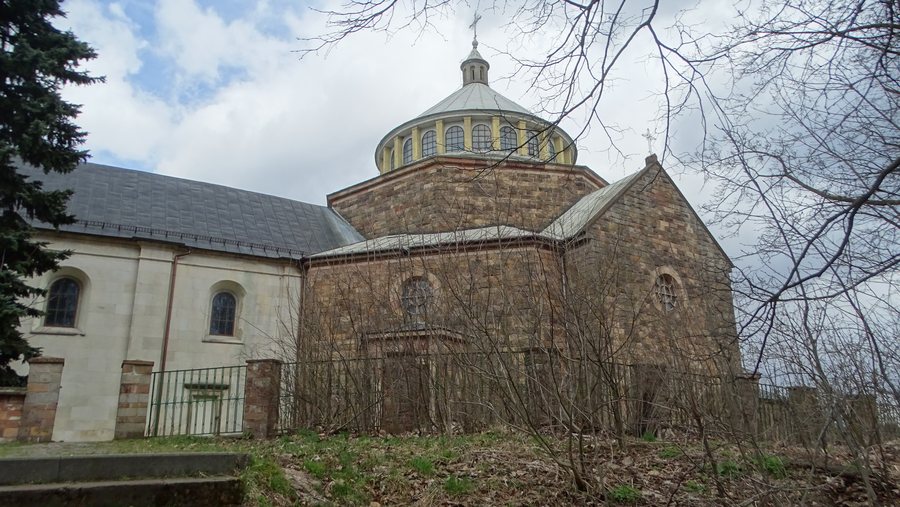
The parish church of Saint Rosalia and Saint Martin was built between 1668 and 1676. It was later extended in two directions: westward from 1898 to 1908 and eastward from 1951 to 1953. This sequence makes the building history particularly easy to trace: the original construction was followed by two clearly dated phases of expansion. Those interested in architectural history can distinguish the changes chronologically.
The preserved furnishings also offer specific points of interest. The church contains Baroque side altars dedicated to its patron saints. The dome features contemporary polychrome paintings depicting scenes from the lives of Saint Rosalia and Saint Martin. The altars and dome paintings create different points of emphasis: the Baroque design of the side altars on the one hand, and depictions of the two patron saints in the dome on the other.
The church also preserves a banner that was carried at patriotic and religious gatherings from 1861 until the January Uprising. A bell tower dating from 1900 stands beside the church. Its commemorative plaque remembers parish residents who fell between 1914 and 1921. Together with the building phases and furnishings, these details provide several points of reference for the church’s history, although they are not all connected to a single event.
Another historical detail can be found in the parish car park: a stone statue of Saint John of Nepomuk, dating from 1774, stands there on a pedestal. Its location in the car park and its precise date distinguish it from the memorials in the bell tower and the church. The natural and cultural attractions thus offer different ways to explore Zagnańsk.
Discover more destinations: Miedziana Góra, Tokarnia, Bieliny, Zaborowice, Kołomań, Chałupki, Święta Katarzyna, Masłów.
For the overview of the wider area: Kielce.

