
Spore – Lake, Gwda River and Neo-Gothic Church
Accommodation in Spore
Spore brings together a lake, a river and a striking landmark, making it a distinctive destination within the wider Szczecinek destination. The village sits on a high bank above the lake; the Gwda also flows through the western part of Spore. This gives you a choice of different interests when planning your holiday: time by the water, a canoe route through the surrounding area or a glimpse of the village’s history.
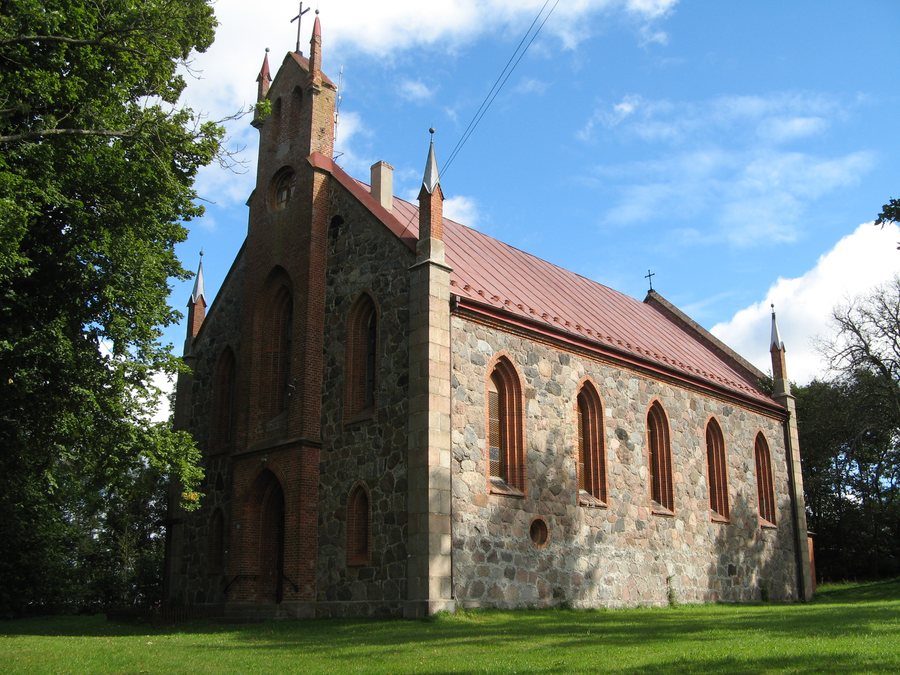 File:2011-08 301 Spore, kościół Najświętszej rodziny (Sparsee Kirche).jpg
Photo: Hans-Peter Balfanz via Source, CC BY-SA 3.0
Lake and lakeside landscape
Lake Spore covers 90 hectares and is suitable for swimming and family recreation. Together with the high bank, it defines the setting of the village. If you are considering a stay by the water, the lake offers a clear focus when choosing your destination. Its suitability for swimming describes the lake in general; it does not indicate conditions on any particular day.
The lake is not the only defining feature of the landscape: the Gwda flows through the western part of Spore. The lake and river are therefore associated with different aspects of the village’s scenery. This distinction can also help with holiday planning if you are looking for a place that offers both a lakeside landscape and a connection to a water route.
A fieldstone landmark
The Neo-Gothic Church of the Holy Family is Spore’s most prominent landscape landmark. It was built from fieldstone between 1859 and 1865. Its construction dates, architectural style and materials give the church a distinct character alongside the lake and the Gwda. If you would like to include a cultural destination in your stay as well as nature and water, this striking building is right in Spore.
Canoeing on the Gwda
The “Gwda” canoe trail passes through Spore, between Lake Smolęsko and Lake Wielimie. Spore is therefore part of a route connecting several bodies of water. The upper section is also relevant for planning a longer trip: it is 45 kilometres long and can be paddled in two to three days as a guide. Almost the entire section lies within the Municipality of Szczecinek. This information refers to the upper section as a whole, not to the time needed to travel the stretch through Spore.
More to explore in the wider Szczecinek destination
The wider Szczecinek destination offers further ways to plan active days beyond Spore. The red-marked “Szlak Wzniesień Moreny Czołowej” hiking trail is 161 kilometres long and passes through the Gmina Szczecinek. The “Szczecineckie Jeziora” cycling route is 65.1 kilometres long and passes through several villages in the municipality, including Spore. The different route lengths and ways of travelling give you a clear basis for distinguishing a walking or cycling trip from the canoe route.
Other landscape features in the wider Szczecinek destination include the “Jeziora Szczecineckie” protected landscape area and Bagno Kusowo, which covers about 300 hectares and is described as one of Poland’s largest and best-preserved Baltic raised bogs. There are cultural attractions too: in Trzebiechowo, the historic heritage includes a palace complex from the second half of the 19th century and a church dedicated to Our Lady of Częstochowa from the third quarter of the same century. These destinations are part of the wider destination, not attractions in Spore.
If you would like to include additional routes and landscapes, the wider Szczecinek destination offers a broader framework for planning. The aviation picnic in Wilcze Laski takes place there every year during the summer holidays; the exact dates vary.
More places in the wider Szczecinek destination
These places are also part of the wider Szczecinek destination: Pilawa, Krągi, Sitno, Drezno, Rakowo, Stare Wierzchowo, Lubowo and Borne Sulinowo.
Go to the wider travel overview: Szczecinek.

