
Rekowo: Archaeology, the Camino de Santiago and a cycling route
Accommodation in Rekowo
Rekowo can be explored through several specific themes: an archaeologically investigated burial mound cemetery, a chapel, historic graves, and routes that pass through or begin in the village. If you are considering Rekowo for your trip to Poland, these different points of interest may shape your decision to visit. The details below can help you decide whether you are more interested in archaeology and local history or in a stage on foot or by bicycle.
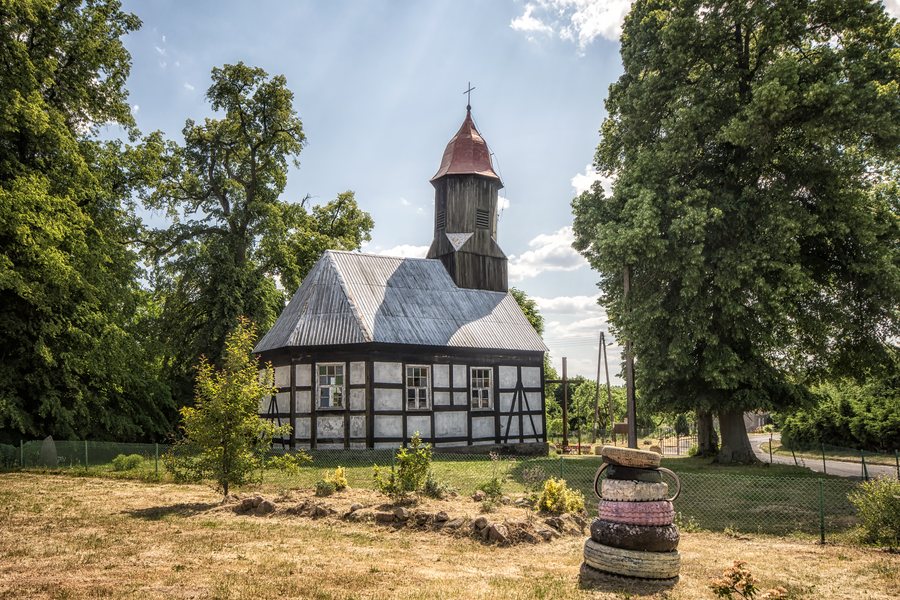 File:SM Rekowo Kościół Apostołów Piotra i Pawła 2023 (9).jpg
Photo: Sławomir Milejski via Wikimedia Commons, CC BY-SA 4.0
File:SM Rekowo Kościół Apostołów Piotra i Pawła 2023 (9).jpg
Photo: Sławomir Milejski via Wikimedia Commons, CC BY-SA 4.0
Archaeological traces and local history
At the archaeologically investigated site in Rekowo, the earliest traces of settlement discovered date back to the Stone Age and the Early Bronze Age. The history of a burial mound also spans different periods: after an earlier phase with cremation graves from the Lusatian culture, it was used again as a burial site during the Roman Imperial period. The earlier phase is dated to around 1200 to 700 BCE, and its renewed use to around 70 to 230 CE. This interpretation is based on archaeological research conducted in 2023 and 2024. What is particularly notable for history enthusiasts is the sequence of periods: it links early traces of settlement with later use for burials, although the two did not belong to the same era.
Rekowo is characterized by its rural settlement pattern. The village is also home to a chapel dedicated to Saint John Paul II, built from 2007 onward. On the outskirts of Rekowo is a former German cemetery, where graves from the 19th century have been preserved. Rekowo therefore brings together different historical points of interest: archaeological traces from distant periods, a cemetery with older preserved graves, and a more recent chapel. If you plan to visit the cemetery, check its condition on site, as it may change.
The Camino de Santiago and a cycling connection
Stage 28a of the Camino de Santiago passes through Rekowo. Here, the route is marked with yellow arrows and a yellow scallop shell. If you include this route in your travel plans, check the waymarks before setting out, as trail markers in the field may change. The stage number helps you place Rekowo along the route; by itself, it says nothing about the trail conditions on the day of your trip.
There is a separate connection for cycling: the cycle route runs from Rekowo via Kolonia Mrówek to Kościernica and connects the municipalities of Manowo and Sianów. Before planning a specific bike ride, check the current signage and surface conditions. The places listed indicate the route’s sequence, but do not replace checking current conditions. The two routes therefore differ in how they are described: the Camino de Santiago passes through Rekowo, while the cycling route connects Rekowo with Kolonia Mrówek and Kościernica.
For your travel plans, this means that Rekowo may interest you if you want to combine historical themes with route planning. Its archaeological history spans different eras, while the Camino de Santiago and the cycling route each offer a different way to include the village in a trip. Consider which focus is most important for your stay, and check trail conditions if you plan to use either route.
Other places
Sucha Koszalinska, Łazy, Biesiekierz, Kłos, Gozd, Sarbinowo, Wielin, Mielno
For the broader travel overview: Köslin.

.jpg)