
Nowe Miasto Lubawskie: Church Art, City Walls and Trails
Accommodation in Nowe Miasto Lubawskie
Nowe Miasto Lubawskie lies in the valley of the meandering Drwęca River. Medieval architectural landmarks and cycling and hiking routes offer different ways to spend your stay: you can explore church art and the town’s history or plan routes towards the Drwęca Valley. The details below will help you balance culture and outdoor activities according to your interests.
 Ruins of the Reformed monastery in Łąki Miejskie
Photo: GringoPL via Wikimedia Commons, CC BY-SA 3.0
Church Art and Medieval Town History
Construction of the Church of St Thomas the Apostle, the Basilica of St Thomas, began around 1300. The main nave features a Gothic wall painting from the second half of the 15th century depicting Christ crucified. The furnishings include several altars from the 17th and 18th centuries; the basilica also has a late Renaissance choir and an organ dating from the early 17th century. The vestibule, too, has a striking architectural detail: its vault corbels are shaped like human heads with demonic grimaces.
Construction of the town walls began in the 1330s. Surviving sections include the Gothic Brodnicka and Lubawska gate towers. Despite later alterations, the Lubawska Gate Tower retains original loopholes and distinctive turrets. Together with the other sections of the walls, the towers offer tangible points of reference for understanding the town’s medieval defensive architecture.
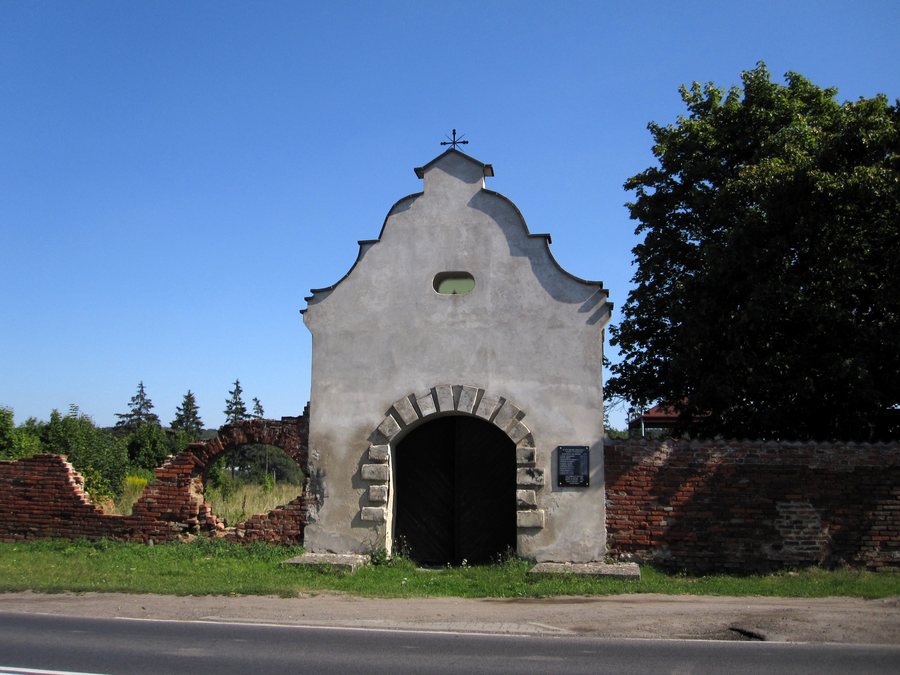
The Brodnicka Tower, also known as Baszta Kurzętnicka, was converted into a town archive in the 19th century and has been home to the Muzeum Ziemi Lubawskiej since 1959. Its collections illustrate the history and everyday life of the region’s inhabitants over several centuries. There are historical details beyond the church and fortifications, too: the parish cemetery preserves old gravestones, a Neoclassical mortuary chapel with adjoining burial chapels, and a cemetery gate. The urban ensemble was entered in the monuments register in 1957; the historic market square retains the character of bygone times.
Cycling and Hiking
The family cycling route starts at the market square, by the tourist information office in the former Protestant church building. The building serves both cultural and tourist purposes as the Kinoteatr Harmonia and tourist information office. The route runs along Kościelna, Działyńskich and Tysiąclecia Streets. If you plan to visit the tourist information office, check its current visitor services before your visit. You should also check the current condition of the route before setting out.
For a hike, the 13 km-long TO-2215 trail is a specific option: it connects Nowe Miasto Lubawskie with the yellow hiking trail in the Drwęca Valley. The starting point is near the former railway station; from there, the route passes through Nawre, Nowy Dwór Bratiański and Chrośle before reaching Radomno. Based on its stated length and the places along the way, this hike differs from the cycling route through the town streets. The information provides a basis for comparing the type of outing and the route.
A 12.8 km cycling route runs between Kurzętnik and Nowe Miasto Lubawskie through the Drwęca Valley, which is protected as part of the Natura 2000 network. The Camino de Santiago pilgrimage route also passes through Nowe Miasto Lubawskie. It continues through the Drwęca Valley, forests and along the shores of the lakes of Warmia and Masuria.
The Landscape
The eastern part of Nowe Miasto Lubawskie lies within the Obszar Chronionego Krajobrazu Doliny Dolnej Drwęcy landscape protection area. Together with the town’s location in the valley of the meandering Drwęca River, this gives the landscape a clear geographical context. The routes mentioned offer different points of interest: the town cycling route follows named streets, the TO-2215 connects places with a hiking trail in the valley, and the 12.8 km cycling route runs between Kurzętnik and Nowe Miasto Lubawskie.
If culture is your main consideration when choosing where to stay, the basilica, gate towers, museum and cemetery offer a range of historical themes. For a more active stay, the specific details about the hiking route’s course and length, as well as the cycling routes, can help you plan. Check the current condition of the trail before setting out, and make your choice based on which of the routes and landmarks described interest you.
More destinations: Kuligi, Kurzętnik, Ostaszewo, Grodziczno.
To the regional travel overview: Nowomiejski.

