
Discover Bartosze
Accommodation in Bartosze
Bartosze offers two distinct points of interest to help you plan your trip: a nature reserve with wetlands and beavers, and a war cemetery connected with the First and Second World Wars. If you are looking for somewhere to stay in Poland, these themes can help you match Bartosze to your travel group’s interests. Nature and history stand side by side here, but each tells its own story.
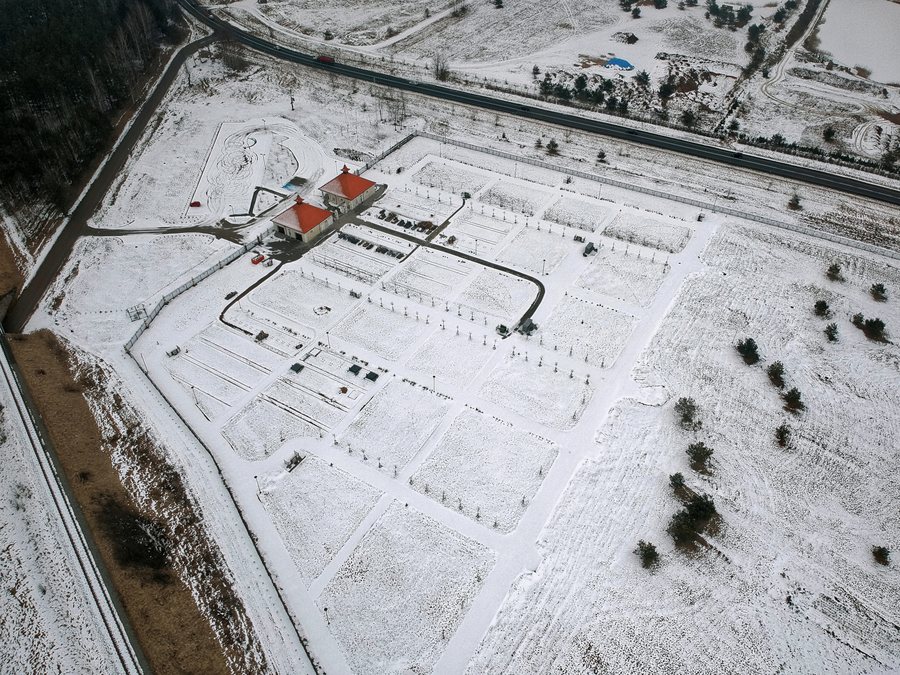 The Municipal Cemetery No. 3, Bartosze near Ełk
Photo: 1957birth via Wikimedia Commons, CC BY-SA 4.0
The Municipal Cemetery No. 3, Bartosze near Ełk
Photo: 1957birth via Wikimedia Commons, CC BY-SA 4.0
Wetlands and beavers in Bartosze
The “Ostoja bobrów Bartosze” nature reserve is located in Bartosze. It protects the European beaver, which lives in marshy terrain along the shore of Lake Szarek.
The “Bartosze” nature reserve covers 190.46 hectares. Its conservation objective, established in 2018, is to preserve and protect ecological processes in wetlands. If nature and landscapes are important to you when choosing a destination, you will find a clearly defined focus here: the protection of these processes.
War cemetery and historical connections
The German military cemetery at Bartossen (Bartosze) was established through cooperation between the Polish Pamięć Foundation and the German War Graves Commission in Kassel, and was inaugurated on 9 August 2003. Around 20,000 Second World War dead are buried in the cemetery. The site lies on a plateau, covers about five hectares, and is accessible by a staircase. Groups of symbolic crosses mark the burial plots of those who died in the Second World War.
The design also gives the site its distinctive character: the natural stone of the enclosure draws on East Prussian architecture. There is a rest area on the cemetery access road, from where three large wooden crosses, visible from far away, can be seen. These features help identify the war cemetery as a carefully designed site. At the same time, the burial plots and crosses preserve the connection to the people buried here.
The cemetery’s history extends beyond the Second World War. The starting point for the establishment of the war cemetery at Bartosze was a small First World War cemetery known as “Golgota Prus Wschodnich.” Eighty-four German soldiers were buried there. The first people buried there had taken part in the so-called Winter Battle of Masuria in February 1915. Eighty-four German soldiers from the First World War are buried in the war cemetery.
Three large crosses, visible from far away, define the entire First World War cemetery. The three crosses at the First World War cemetery are part of the burial site; three large wooden crosses can be seen from the rest area on the access road. This helps you distinguish the historical connections by period: the burial site commemorates those who died in the First World War and the Winter Battle of 1915; the military cemetery also contains the graves of those who died in the Second World War.
Bartosze as a destination for your trip
Your decision depends on which focus best suits your trip. The nature reserve highlights wetlands, ecological processes, and the European beaver along the shore of Lake Szarek. The war cemetery, by contrast, offers specific historical connections, a history spanning several decades, and a clearly described design. These two themes give you different reasons to take a closer look at Bartosze, without having to combine them into a single excursion theme.
For a better sense of what the area offers, consider the specific differences: nature and wetland conservation on the one hand, and the history of war cemeteries on the other. This lets you choose a destination based on what you would like to discover on site or understand in its historical context.
Discover more destinations: Szeligi, Ruska Wies, Chrzanowo, Zawady Ełckie, Rękusy, Nowa Wieś Ełcka, Ełk, Kalinowo.
For the wider travel overview: Lyck.

As.jpg)