
Discover Rzepedź: landscapes and Lemko culture
Accommodation in Rzepedź
Rzepedź reveals itself through its location in the Rzepedka Valley, a church connected to Lemko architecture and several tangible traces of regional history. There are also a basketball court, a tennis court and a barbecue area. This combination helps you assess the town from different perspectives when planning a trip to Poland: landscape, sacred heritage, Lemko traditions and a chapter in the history of forestry. When deciding whether it is the right destination for you, the key question is which of these aspects interests you most.
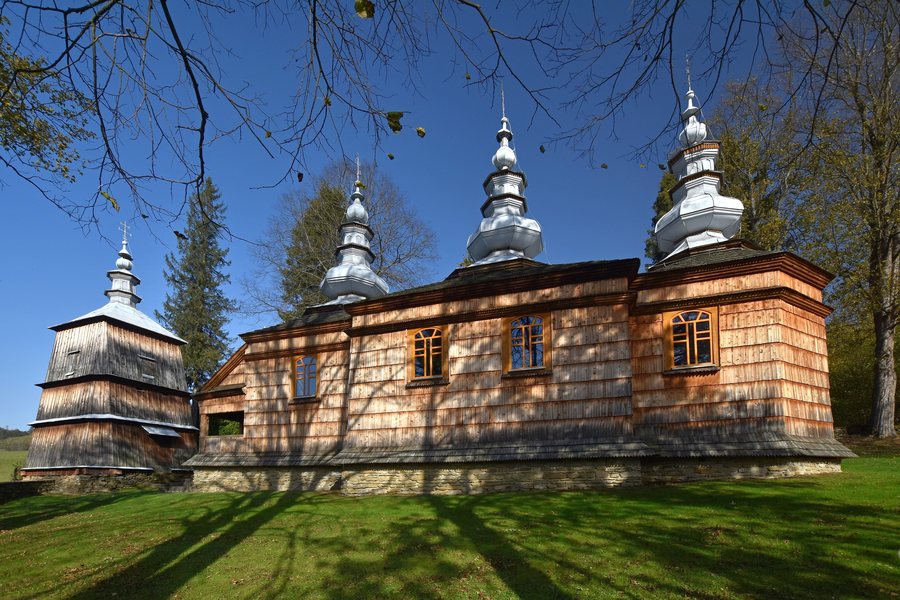 File:Rzepedź, cerkiew św. Mikołaja (HB6).jpg
Photo: Henryk Bielamowicz via Wikimedia Commons, CC BY-SA 4.0
File:Rzepedź, cerkiew św. Mikołaja (HB6).jpg
Photo: Henryk Bielamowicz via Wikimedia Commons, CC BY-SA 4.0
Valley, river and ridges
Rzepedź lies in the Rzepedka Valley, where the Rzepedka flows into the Osława not far from the town. To the north rises the treeless Rzepedka Ridge, at an elevation of 708 metres; to the south lie three open summits at 508, 500 and 510 metres. These details make the landscape’s structure tangible: alongside its valley setting, there is a named ridge and three individually specified elevations. If you like to understand places through their terrain, Rzepedź offers more than a general description as a valley town. The precise positions of these landforms in relation to one another are also part of the town’s character.
Church and Lemko heritage
The Greek Catholic Church of St Nicholas is a tangible architectural landmark in the town’s history. It is enclosed by a rubble-stone wall, and its entrance gate is roofed. The church also represents a type of sacred architecture that developed in Lemko communities. A visible architectural detail and a cultural context thus stand side by side: the wall and gate describe the ensemble, while the architectural style links it to Lemko communities. For travellers interested in regional architecture, this connection offers a distinct way to discover the town.
Another link to Lemko culture comes through Jan Kanty Podolecki. He lived in the Osława Valley for 20 years and made numerous hikes from Rzepedź, where he came to know the mountains and their inhabitants. During these journeys, he collected Lemko folk songs and stories and described the customs and rites of the Lemkos who lived there. Rzepedź is therefore also connected to a specific history of cultural documentation: Podolecki’s stay in the valley and the routes he took from this town shaped the context for his encounters and cultural collections.
A historic forest railway
The construction of a historic forestry railway is also part of the region’s history. Work began in 1921. The line ran from Rzepedź along the Osława towards Duszatyn; by 1923, the first section had been completed. It was ten kilometres long and ran from Rzepedź to Duszatyn. The start date, completion and length of the section give this chapter a clear timeline and geographical context. Its route along the Osława adds a historic transport link, originating in Rzepedź, to the picture of the river valley.
Local features to help plan your trip
Rzepedź has a basketball court, a tennis court and a barbecue area. These add specific sports and leisure facilities to the town’s landscape and cultural history. Each offers something different: basketball and tennis are sporting activities, while the barbecue area offers another kind of leisure. If you want to consider local amenities alongside landscape and history when choosing a destination, these facilities offer another aspect to take into account.
When choosing a destination, you can distinguish between a focus on the landscape and one on cultural history. The valley, the confluence of the Rzepedka and the Osława, and the ridges shape the landscape around Rzepedź. The church, Lemko heritage and the history of the forest railway, by contrast, offer concrete points of interest for exploring the town’s cultural history. This can help you assess the town based on which of these subjects matters most to your trip to Poland.
More destinations
Wysoczany, Czystogarb, Nowy Łupków, Tyrawa Solna, Zagórz, Kalnica, Sanok, Zahutyń
For the broader travel guide: Sanok.

.jpg)