
Hruszowice: Sacred Buildings from Different Periods
Accommodation in Hruszowice
For a trip to Poland focused on cultural history, Hruszowice offers religious buildings from different periods and an early medieval castle mound under legal heritage protection. Nearby, Kopiec Monastery adds archaeological traces of settlement to the picture. This brings sacred architecture and settlement history together, while the sites and their respective dates can be considered separately.
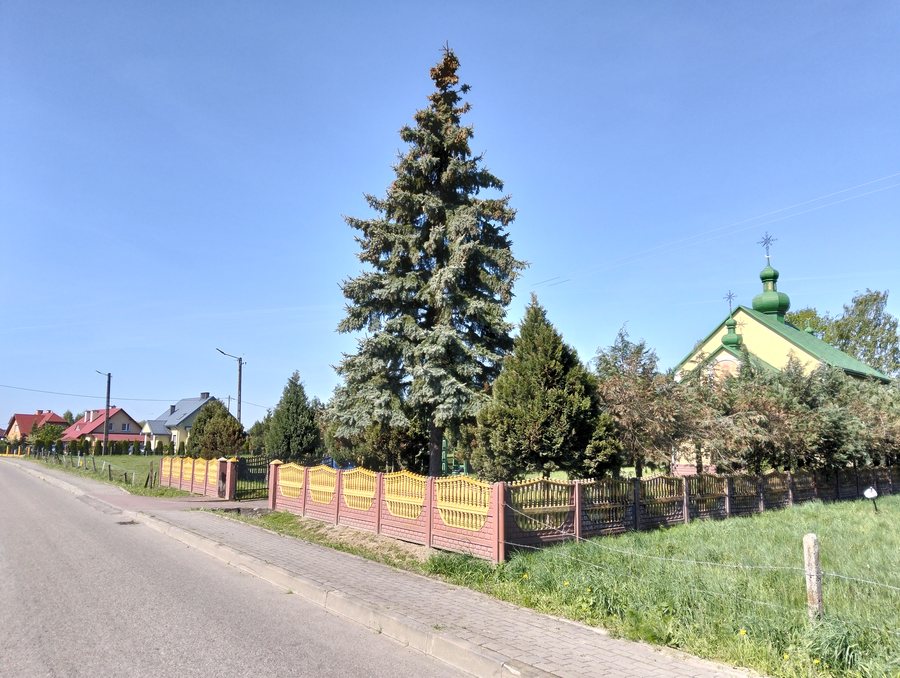 File:MOs810 Wikigrant 10 2025 Resovia (Greek Catholic Church in Gaje) (1).jpg
Photo: MOs810 via Wikimedia Commons, CC BY 4.0
Churches from Different Periods
A municipal document from 2018 describes a masonry burial chapel from the 19th century as a Roman Catholic church. Alongside it stands the Greek Catholic Church of the Dormition of the Most Holy Mother of God. It is a three-part brick building dating from 1996 to 1999. The two buildings offer different points of interest: the chapel is described in terms of its funerary character, masonry construction, and 19th-century date; the Greek Catholic church is defined by its three-part form, brick construction, and precisely stated building dates.
The furnishings and the structure beside the church provide further specific details. Inside is a contemporary iconostasis that comes from the church in Olchowiec. Its origin adds a distinct connection to another church site to the building’s history. A small bell tower with a metal-and-wood canopy also stands beside the Greek Catholic church. Thus, brick, metal, and wood play different roles in the same building complex: as the church’s construction material, as interior furnishings, and as the material of the neighboring tower.
Castle Mound and Archaeological Settlement Traces
The early medieval castle mound in Hruszowice is under legal heritage protection. It differs in subject from the churches: here, the focus is on an early form of fortification and settlement, while the churches are described in terms of their construction, function, and furnishings. For a cultural-history trip, it offers a different perspective on the area without combining the different buildings into a single story.
The nearby area also includes Kopiec Monastery, located a little farther away among fields. It is described as a local archaeological site with settlement remains of the castle-mound type. Outlines of pits and remains of hearths dating from the 12th to 13th centuries were discovered there. These specific finds give the archaeological theme a different character from the protected castle mound in Hruszowice: at Kopiec, traces of individual pits and hearths are identified, while the castle mound is classified as an early settlement site.
The dates also help distinguish the two sites: the castle mound in Hruszowice is described as early medieval; the remains of pits and hearths at Kopiec date from the 12th to 13th centuries. If you are interested in cultural history, you can include these different themes in your trip planning and decide which of them matters most for your stay.
Discover more destinations: Bolestraszyce, Kalwaria Pacławska, Łodzinka Dolna.
Back to the main travel overview: Przemyski.

