
Discover Hoczew: History and the Hoczewka
Accommodation in Hoczew
You can get to know Hoczew through its local history, the Fredro family, the church and the Hoczewka River. The surviving details range from a written record dating to 1400 to a painting from the late 17th century. The river landscape where it meets the San adds another dimension. If you are considering Hoczew as a destination, these different topics offer concrete clues about which aspects of its history and geographical setting interest you.
A place with a long history
Hoczew is one of the oldest places in the Bieszczady and is documented in writing as early as 1400. At that time, it was called Oczew. This early record and the older form of the name give the local history a clear starting point in time: Hoczew is defined not only by its present-day name, but also by a name that appears in written records from 1400. Anyone interested in putting a destination’s history in context will find a concrete link here between the place name and a date.
Traces of the Fredro family
The Fredro family gave Hoczew its name and had a manor house built there. The family’s history is also connected with the village: Jacek Fredro, the father of playwright Aleksander Fredro, was born in Hoczew. These two details tell different aspects of the same local history. The naming and the manor house point to the family’s presence in Hoczew; Jacek Fredro’s birthplace adds a biographical connection.
The church, its construction history and an older painting
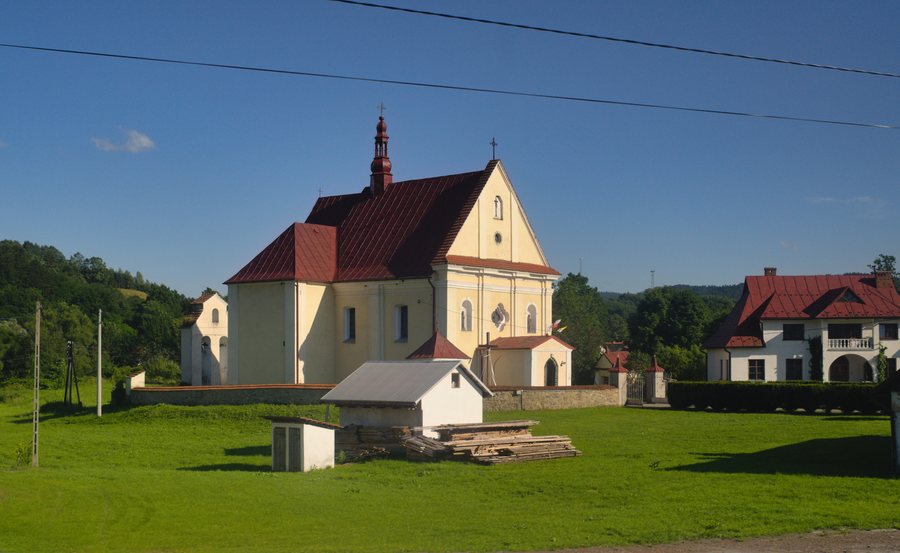
The church building was erected in 1744. The masonry screen bell tower at the church and the rectory both date from the same period. This places both structures in the timeline of the church’s construction. This connection is useful when putting the architecture in context: the bell tower and rectory are not recorded as unrelated historical details, but share a connection to the construction period of the building erected in 1744.
The main altar features a painting of Saint Anne with Mary and the Christ Child. It dates from the late 17th century, making it older than the 1744 church building. The painting probably came from the predecessor church. Its provenance is therefore considered probable, rather than certain. Together with the construction dates, this gives us two distinct periods: the older altarpiece and the period when the church, bell tower and rectory were built.
The Hoczewka and its short course
The waterways also give Hoczew a distinct geographical character. The small Hoczewka is formed where the Jabłonka and Rabiański Potok streams meet. After a short course, it flows into the San at Hoczew. Its formation and route are therefore closely linked to these streams and the village.
What to consider when choosing where to stay
These topics highlight different aspects of the village: the year 1400 and the earlier name Oczew lead to its written history, while the Fredro family adds connections to its name and a biography. The church offers a way to distinguish between the construction period and the artwork, while the Hoczewka provides a geographical perspective. If you are looking for hotels in Hoczew, you could start by considering which of these aspects of the village is of particular interest to you on your trip. This information can help you put Hoczew in context as a destination; check the specific hotel listing for details about a particular property.
Discover more destinations: Łukawica, Manasterzec, Mchawa, Uherce Mineralne, Smerek, Górzanka, Wetlina, Lesko.
For the main travel overview: Leski.

