
Jedlnia-Letnisko: Reservoir, Wooden Architecture and Festival Tradition
Accommodation in Jedlnia-Letnisko
Jedlnia-Letnisko can be explored through three specific features: the reservoir on the Gzówka, protected old-growth trees and a building history in which wooden summer houses and a wooden church each make their mark. There is also the Święto Polskiej Niezapominajki, held annually in mid-May. When choosing your destination, you can consider whether you would like to focus primarily on the landscape, historic wooden architecture or a local tradition.
Reservoir and protected old-growth trees
The artificial reservoir on the Gzówka was created in 1976 and covers 40 hectares. There are sandy and grassy beaches by the reservoir. The “Jedlnia” nature reserve protects natural old-growth trees on the reservoir’s right bank. This brings together two distinct landscape features: an artificially created body of water and a protected stand of old trees. The year it was created and its area give the reservoir a specific historical and geographical context; the forest’s protected status, by contrast, identifies what is being preserved in this part of the landscape.
Wooden architecture with several influences
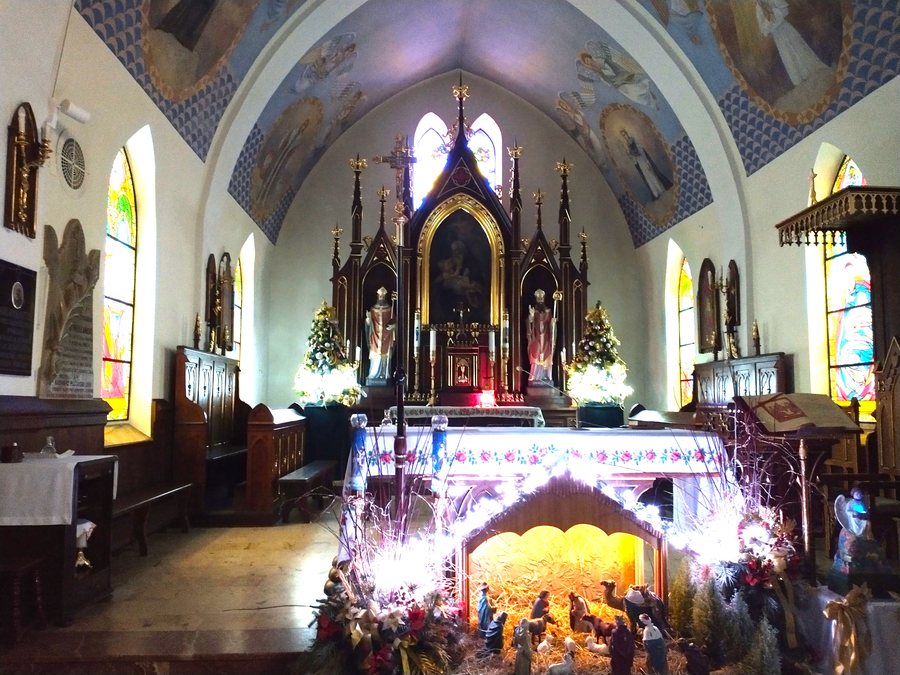
The history of the buildings offers several clearly distinct ways to explore the town’s past. St. Joseph’s Church in Jedlnia-Letnisko is a wooden church in the Zakopane style. One of the villas, over a hundred years old and still standing today, was built by Czesław Golczewski in 1898. The first summer houses, modeled on Świdermajer villas from the Warsaw area, were built on what is now Ulica Nadrzeczna around the turn of the 19th and 20th centuries. The comparison of dates is precise: 1898 is the construction year of a specific villa, while the turn of the century marks the period when the first summer houses appeared on the street. Thus, a specifically dated building and the development of an early summer-house district offer two distinct perspectives.
Świdermajer is a wooden architectural style influenced by traditional forms from Masovia, Russia and Switzerland. The two stylistic references make different contributions: the church is identified with the Zakopane style, while the summer houses are modeled on Świdermajer villas. The connection to the Warsaw area and the influences mentioned place local architectural history in a broader context.
A festival as a seasonal highlight
The festival tradition also gives the town a recurring seasonal marker. The Święto Polskiej Niezapominajki is held annually in mid-May at the Leśny Ośrodek Edukacyjny. The festival’s 23rd edition took place on May 12 at the Leśny Ośrodek Edukacyjny im. red. Andrzeja Zalewskiego in Jedlnia-Letnisko. These details are useful for travel planning in different ways: the annual schedule points to mid-May, while May 12 was the date of that particular edition. If you would like to include the festival in your trip, check the dates for your travel period in advance.
The festival therefore provides a seasonal reference point, while the reservoir and wooden architecture are enduring features of the town. If you would like to focus on something specific when planning your trip, you can explore the landscape and architectural history regardless of the festival date; for a trip centered on the Święto Polskiej Niezapominajki, mid-May is the relevant time of year.
Discover more destinations
Discover more destinations: Pionki, Radom, Jedlińsk, Mleczków, Podgóra, Skaryszew, Iłża, Waliny.
Back to the main travel guide: Radom.

_(12).jpg)