
Zaręby Kościelne: City History and Sacred Architecture
Accommodation in Zaręby Kościelne
Zaręby Kościelne brings together memories of its former city status and distinctive architectural and artistic works. If, on your trip to Poland, you want to learn about more than just the landscape and explore the history of a place, you’ll find several points of interest here: preserved buildings along ul. Rynek, a former Reformati monastery, a Neo-Gothic parish church, and a monument to Maria Curie-Skłodowska. The buildings’ history spans different periods, from the 18th to the 20th century. The streetscape, sacred architecture, and public memorials offer different perspectives on the town.
The Town’s Former History Along ul. Rynek
Until the January Uprising, Zaręby Kościelne was a town. Its preserved buildings, particularly along ul. Rynek, bear witness to this former status. The street is therefore a tangible point of reference if you want to trace how the town has changed over time. The traces along ul. Rynek make the town’s history tangible in a named part of the town, while the church complexes have their own building phases. This places the town’s former history and its sacred buildings side by side as distinct, yet locally connected, themes.
The Monastery Courtyard and Its Layers of History
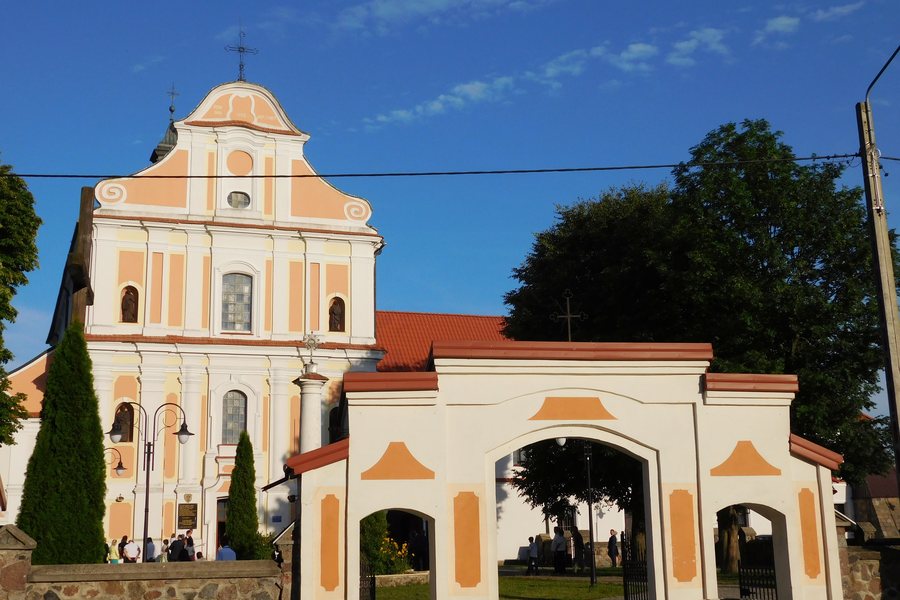
The church and former Reformati monastery in Zaręby Kościelne were built from 1765 to 1774, thanks to a foundation by Szymon Zaręba. Zaręba was castellan and land judge of Sieradz. His foundation links the building’s history to a specific person and his offices. Three precisely dated features stand in the walled, square courtyard: a Tuscan column from 1805, a statue of the Immaculate Conception erected in 1862, and an ossuary built in 1961.
Almost two centuries separate the construction of the complex from the most recent of these courtyard features. The dates help place each element in its own time, rather than viewing the courtyard as the result of a single building phase. The column, statue of Mary, and ossuary each offer a distinct point of reference; together, they make the long history of the monastery courtyard tangible. This provides a clear focus for planning your trip, taking into account both the creation of the complex and its later additions.
Church Art and Public Memorials
The church complex includes the Detyniecki family burial chapel, built in 1861. It connects the former and present-day church complexes. The chapel is therefore not only a dated building, but also a reminder of the connection between different phases in the church complex’s history.
The parish church of St. Stanislaus the Bishop is a Neo-Gothic building made of fieldstone and brick, built from 1882 to 1900. A Sarmatian portrait of Szymon Zaremba hangs in the side aisle. It is the only work of this kind in Ostrów County. The building and painting offer different points of interest: the church can be understood through its style and materials, while the portrait is notable for its named subject and special status in the county. In Zaręby Kościelne, you can encounter both architectural history and an exceptional example of portrait art.
A monument to Maria Curie-Skłodowska stands beside the municipal library building. Flowers are laid at the monument, and competitions for schoolchildren are also held annually. This site adds a named person and recurring commemorations to the town’s architectural history. The competitions are specifically for schoolchildren, making them a distinct aspect of public life, while the flowers at the monument are another form of tribute.
Getting There and Finding Accommodation
There is a railway station of the same name in Zaręby Kościelne. Before you travel, check the current departures for your travel dates so you can plan your connection accordingly. The station is a useful point of reference for planning your journey; current departures are key to choosing your route.
If you’re looking for a hotel for a culture-focused trip, you can include Zaręby Kościelne in your options if its former city history and sacred architecture fit your itinerary. The town’s historical highlights are clearly identified: the buildings along ul. Rynek, the monastery courtyard, the church complexes, and the monument. Also include train connections that suit your travel dates in your plans.
Discover more destinations: Nagoszewo, Ostrów Mazowiecka, Brok
Return to the main travel overview: Ostrów.

