
Szczaniec: Church, Townscape and Palace Ruins
Accommodation in Szczaniec
A distinctive way to discover Szczaniec is through its architectural history and townscape: the town preserves a well-preserved medieval layout. Other features include St. Anne’s Church, palace ruins with structural elements from different centuries, a granary from the late 18th century, and masonry buildings, many of which date from the second half of the 19th century and the beginning of the 20th century. This makes Szczaniec a destination for culturally minded travellers interested in exploring not just a single building, but a range of historical traces.
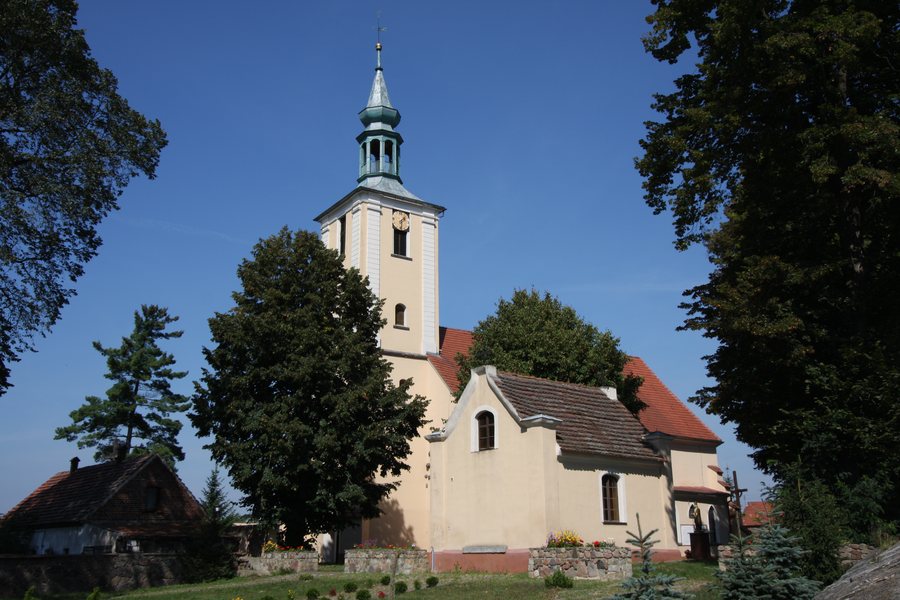
St. Anne’s Church and Late Gothic Architecture
The present-day church in Szczaniec was built around 1570 in the Late Gothic style. The parish church of St. Anne was constructed incorporating an earlier building. It is a single-nave, three-bay Gothic church with a stellar vault. These terms offer several ways to take a closer look at the building: “single-nave” describes its basic layout, “three-bay” its division into three bays, and “stellar vault” the form of its ceiling. Those interested in church architecture can consider both the spatial layout and the design of the ceiling. The incorporation of an earlier building is also part of the church’s architectural history, adding another historical layer to its date.
The church is not the town’s only point of reference in time. Its construction around 1570 can be considered alongside other building phases: parts of the palace ruins date from the second half of the 16th century, while others are from the 18th century. This comparison helps distinguish the different periods without combining them into a single construction period.
Town Plan and Historic Buildings
The medieval town plan also makes Szczaniec a destination for visitors interested in the structure of a historic town. A town plan describes the spatial layout of a settlement; in Szczaniec, this medieval layout is well preserved. This draws attention not only to individual buildings but to the town as a whole. The masonry buildings add another historical layer: many of the one- and two-storey buildings date from the second half of the 19th century and the beginning of the 20th century. The descriptions of their height and period of construction provide specific details without assigning all the buildings to the same construction phase.
Palace Ruins and Granary
The palace ruins bring together structural elements from different centuries. The western section dates from the second half of the 16th century and was built by Eustachy Stencz. The eastern section is a two-storey Baroque building from the 18th century. For historical context, it is important to consider these sections separately: the western section and the eastern Baroque building were constructed at different times and do not constitute a single construction phase. Those interested in architectural history will find a clear chronological contrast between the second half of the 16th century and the 18th century.
Another distinctive building is the granary in Szczaniec. It was built on a rectangular plan and dates from the late 18th century. Its shape and date distinguish it from the church and the sections of the palace ruins. Together, these buildings offer different starting points for exploring local history, without needing to be viewed as a single ensemble.
A Local Cultural Event
Alongside its historic architecture, the Dni Ziemi Szczanieckiej is part of Szczaniec’s cultural profile. This local cultural event is held annually. It adds a recurring cultural perspective to the town’s historical themes. When planning your trip, you can decide whether you are particularly interested in historic architecture and the medieval town plan, or whether you would also like to take the annual cultural event into account. The town’s architectural history remains a distinct way to explore the area, independent of the event.
More Places to Explore
More places to explore: Lubrza, Łagów, Kłodnica, Zbąszynek, Mostki, Świebodzin, Rokitnica, Niedźwiedź.
For the broader travel overview: Świebodzin.

