
Terespol: City History, Fortress and Remembrance
Accommodation in Terespol
Terespol offers a cultural and historical perspective that spans the town’s origins, the construction of the fortress, and commemorative culture. In 1697, the place was granted town rights and given the name Terespol; in 1913, the Prochownia was built as part of the Terespol bridgehead within the Brest Fortress. A mural commemorates the Żołnierze Wyklęci. These points of reference relate to different periods and topics, showing that Terespol’s history is not limited to a single structure.
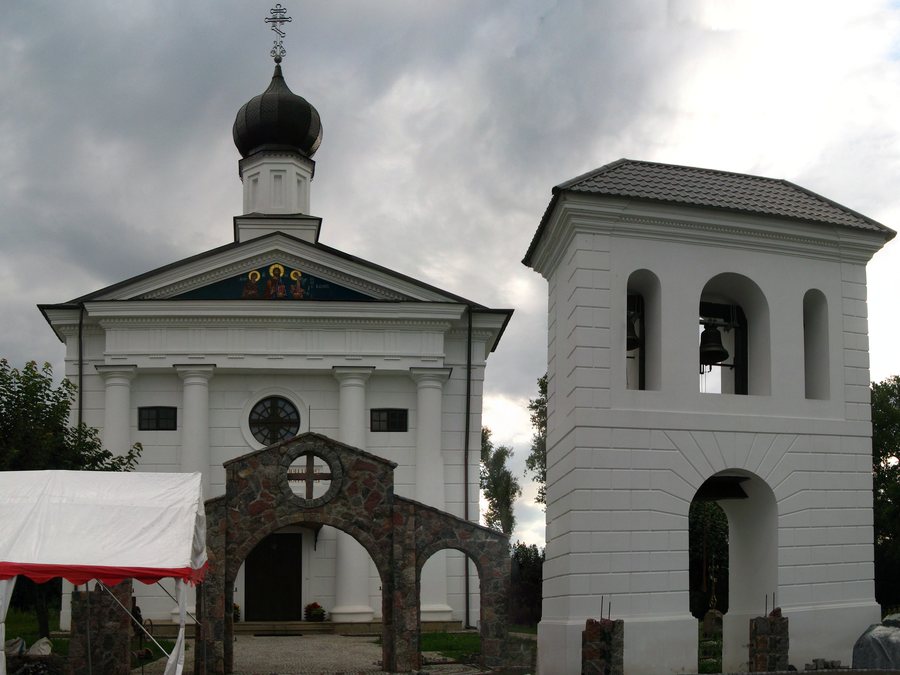 File:Cerkiew prawosławna p.w. św. Jana Teologa (k. XVIII) Terespol 01 JoannaPyka.JPG
Photo: JoannaPyka via Source, CC BY-SA 3.0 pl
Town Rights and Political History
In 1697, Terespol was granted town rights and renamed from Błotków to Terespol. Both changes took place in the same year: the place received a new name and, at the same time, an explicitly designated municipal status. This provides a concrete starting point for understanding its history, as the town’s name history is linked here with its development into a town. This chapter first looks at municipal history, distinguishing it from the references to fortress construction and commemoration.
Another facet concerns political power relations. Karol Stanisław Radziwiłł had Terespol burned down. Jan Detlov Flemming, the owner at the time, supported the Czartoryski during the Sejms and therefore often opposed the Radziwiłłs. This brings political affiliations into view alongside the event itself. For context, this history of political rivalries adds a different perspective on Terespol’s past to the town’s name history.
The Prochownia in the Brest Fortress
The Prochownia was built in 1913 as part of the Terespol bridgehead within the Brest Fortress. This places the structure in the town and explicitly situates it within the history of the fortress. The year provides a clear point of reference for its construction history; it stands alongside the earlier milestone of 1697. When comparing Terespol’s cultural aspects, this reference leads from municipal status to a specific military-historical context.
The structure’s history also includes its rescue from decay: the Koło Miłośników Fortyfikacji i Historii from Terespol saved the Prochownia through its own work. This preservation effort adds a local aspect to the story of its construction. The two topics answer different questions: the structure’s place within the fortress situates it historically, while its rescue tells of the work that saved it from decay. This makes it possible to distinguish the Prochownia’s military context from its preservation history.
A Mural as a Memorial
Terespol also has a mural commemorating the Żołnierze Wyklęci. It adds an explicitly identified subject of commemoration to the town’s and fortress’s history. This distinguishes it from the Prochownia: there, the focus is on its place in the Terespol bridgehead within the Brest Fortress; the mural commemorates the Żołnierze Wyklęci. This gives you two different cultural perspectives to consider when planning your trip: a military-historical structure and a memorial.
Discover more travel destinations: Horbów, Małaszewicze, Grabanów, Czosnówka, Janów Podlaski, Bubel-Łukowiska, Pratulin, Leśna Podlaska.
For the broader travel overview: Bialski.

