
Aleksandrów: Local History, Culture and Settlement Pattern
Accommodation in Aleksandrów
Aleksandrów can be understood through several specific themes: its founding history, a religious sculpture, music and customs, and the development typical of a street village. Together, these features combine local history, culture and settlement pattern into a multifaceted picture of the place.
Origins and Cultural Traces
Aleksandrów was founded in 1791 by Andrzej Zamoyski on the land of the village of Łukowa. This places its origins in the late 18th century and gives the local history a specific time reference. The connection to the land of Łukowa also locates the place of its founding. Aleksandrów is also home to a brick figure of Saint Stanislaus (Stanisław) dating from the 18th century. As a religious sculpture, it adds a distinct cultural motif to the founding history: its brick construction, the saint depicted and its date give this cultural artifact its character.
The Gminna Orkiestra Dęta, the municipal brass band, was founded in 1934 at the Church of Our Lady of Perpetual Help (Matki Bożej Nieustającej Pomocy). This establishes a specific musical connection to a named place and year. Folk and traditional customs ensembles were also active in Aleksandrów in 2009. This second reference draws attention to local traditions as another cultural theme.
The dates form a concise timeline: the founding of the village and the figure date to the 18th century, the band was founded in 1934, and the ensembles were active in 2009. This makes it possible to distinguish chronologically between the origins of the place, specific musical history and links to folk traditions. The dates vary in precision: Aleksandrów was founded in 1791, while the figure is broadly dated to the 18th century.
Settlement Pattern and Municipality
The settlement pattern offers a different way to understand the place: Aleksandrów has a layout typical of a street village. The term refers to a settlement arranged along a road and describes the structure of the place, rather than a single monument. For travelers who want to connect local history with the structure of a place, this settlement pattern complements the dated cultural references with a spatial perspective. Aleksandrów can thus be understood through both specific historical sites and its settlement character.
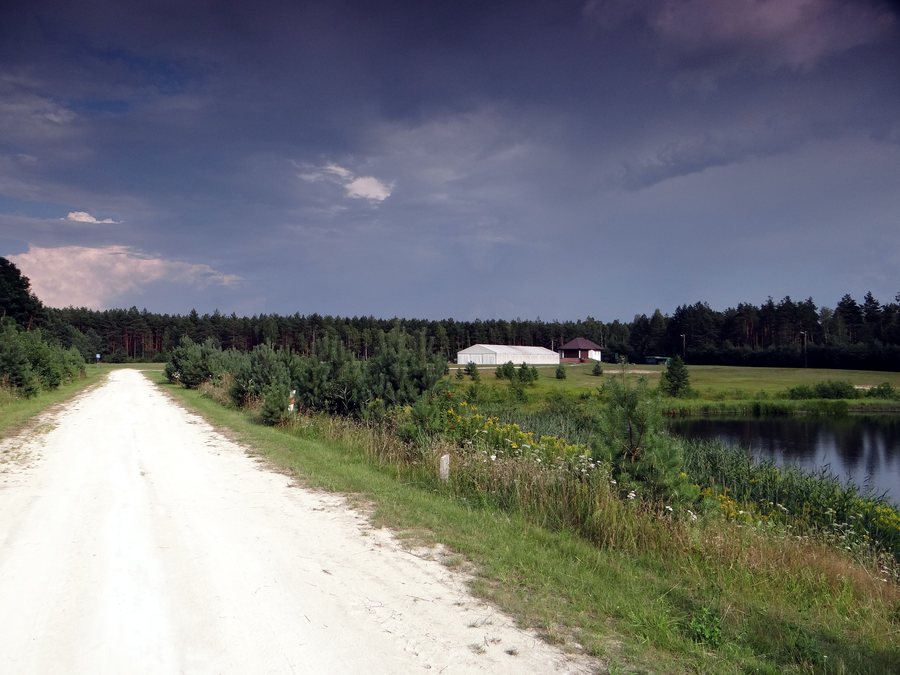
The reservoir on the Szum offers a distinct municipal perspective. It is located in the Sigła colony within the municipality of Aleksandrów and serves as a small-scale water-retention facility. The term describes the local retention of water and clarifies its water-management function. For spatial orientation, the distinction between the village and the municipality is important: the reservoir lies within the municipality, not in the village of Aleksandrów itself. If you are looking for the site on a map, Sigła colony is the key location reference. This makes clear that water is a feature of the municipality, while history, culture and settlement pattern are associated with the village.
Discover more destinations
Tarnogród, Biłgoraj, Tereszpol-Kukiełki, Podsośnina, Lipowiec, Obsza, Borowina
For the overview of the wider region: Biłgoraj.

