
Discover Grudza: a church, historic houses and wide-ranging views
Accommodation in Grudza
From Grudza, the view stretches across the Góry Izerskie (the Jizera Mountains) and the Karkonosze (Giant Mountains). This landscape perspective is a good starting point for considering the village as a travel destination: Grudza appeals both to travellers interested in architectural history and to those who take the surrounding mountain landscape into account when choosing where to go.
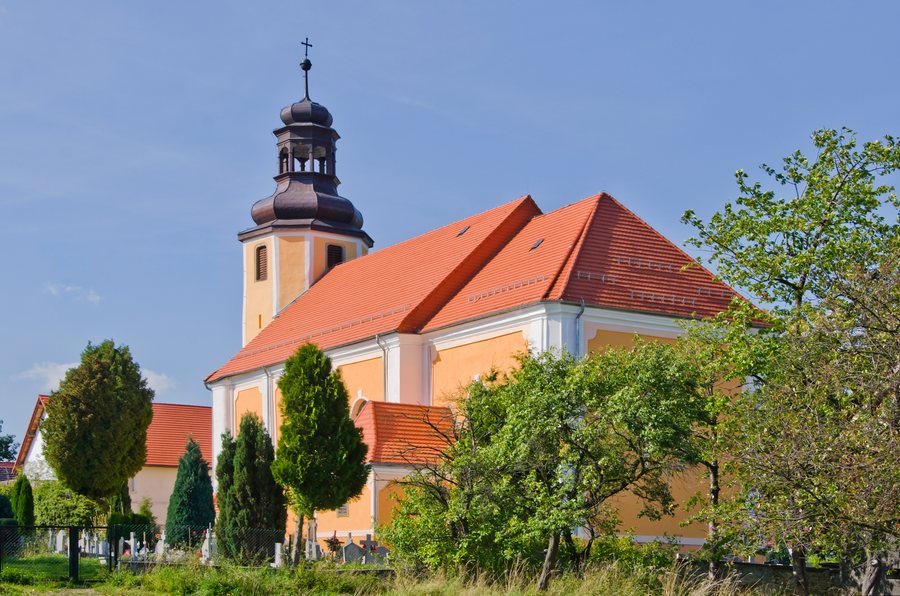 Church of the Name of the Blessed Virgin Mary in Grudza
Photo: Enamo via Wikimedia Commons, CC BY-SA 3.0 pl
Church of the Name of the Blessed Virgin Mary in Grudza
Photo: Enamo via Wikimedia Commons, CC BY-SA 3.0 pl
The landscape as a guide to choosing
The expansive views are one of Grudza’s distinctive features. If you are comparing different destinations in Poland, the prospect of seeing two mountain ranges can be a helpful point of reference: here, the landscape is clearly part of the picture the village presents. This complements its historical attractions without reducing Grudza to a single building or sight.
When planning your holiday, it is worth considering these themes separately. The views offer a sense of the landscape; the church, houses and windmill ruins provide a glimpse into the village’s history.
The Parish Church of the Holy Name of Mary
The Parish Church of the Holy Name of Mary was built in its present form between 1765 and 1768. This date places the building within a specific period of the village’s history and makes it interesting to travellers who are keen to explore historic church architecture. Its date alone sets it apart from the older architectural styles also found in Grudza.
The church’s Baroque furnishings include an organ case, the high altar with the Madonna and Child, a pulpit and 18th-century oil paintings. Each element offers a different way to explore the church’s interior, from the altarpiece and pulpit to the organ case. So it is not just the age of the building that matters, but also the artistic design associated with the church.
Historic houses and architectural styles
Grudza is home to around 50 historic houses, including buildings in the przysłupowy style. This approximate figure gives a sense of the scale of the village’s architectural heritage. The distinctive building style also draws attention to more than the age of the buildings: it offers a specific architectural feature to look for when exploring the houses.
For visitors interested in regional architecture, the historic houses offer a different focus from the parish church. Here, the subject is residential buildings and a named architectural style; there, it is a church and its Baroque furnishings. This distinction helps you view Grudza’s architectural history from several angles rather than treating different types of buildings as interchangeable.
The windmill ruins in the village’s history
Grudza has the ruins of a windmill that served as an observation tower before the Second World War. Its former purpose gives the ruins a distinct historical significance: they are not only the remains of a windmill but also a reminder of its use as a vantage point at the time.
Grudza is thus home to different forms of local heritage: a parish church in its present form dating from the 18th century, historic houses and ruins that once served as an observation tower. If you are choosing a destination based on its historical features, these differences may help guide your decision. The wide views of the mountains add a landscape perspective to the picture.
Discover more destinations
Discover more destinations: Pasiecznik, Lwówek Śląski, Tarczyn, Chmieleń, Kłopotnica, Przecznica, Pokrzywnik, Wleń.
For the overview of the wider area: Lwówek Śląski.

