
Szarocin: Palace Ensemble and Park History
Accommodation in Szarocin
Szarocin Between Parkland and Local History
When choosing a destination in Poland for its cultural and landscape connections, Szarocin can be viewed through two themes: the palace and its park ensemble, and areas of Rudawski Landscape Park within the local forest district. Understanding the exact geographic context helps distinguish the local connection from the wider park landscape. This makes it possible to discover Szarocin not only through individual buildings, but also through its surroundings and their connection to protected areas.
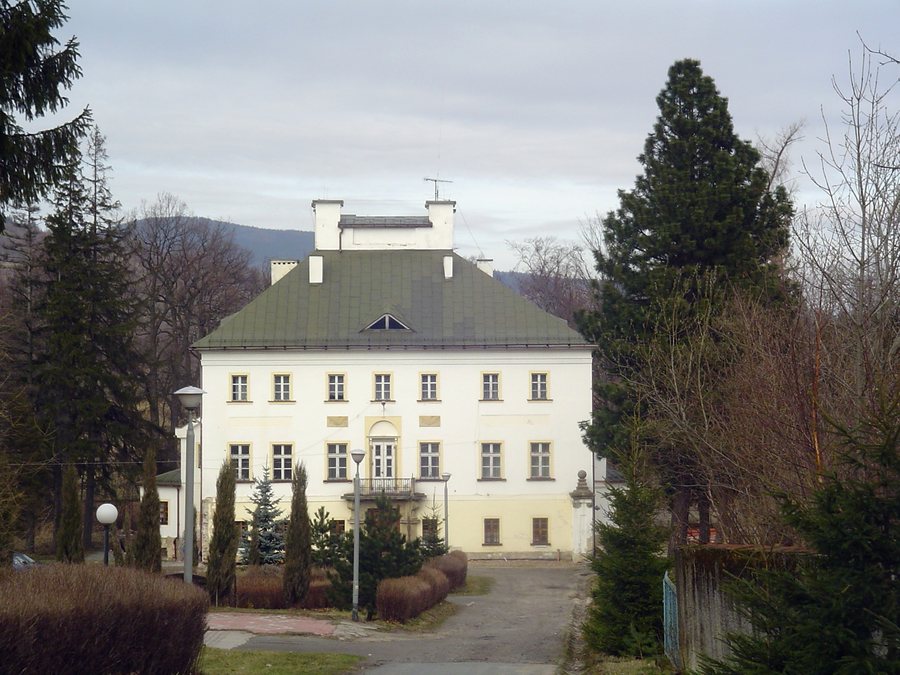 File:Pałac w Szarocinie (fot. 2007).JPG
Photo: Edward Knapczyk via Wikimedia Commons, CC BY-SA 3.0 pl
Areas of Rudawski Landscape Park and its buffer zone lie within the Szarocin Forest District, part of the Kamienna Góra Forest Inspectorate. This does not mean that the entire town lies within the park. For a regional perspective, the area figures for the forest inspectorate’s jurisdiction are useful: the portion of the park there covers 3,094.58 hectares, with a further 85.36 hectares in the buffer zone. These figures refer to the forest inspectorate, not to Szarocin alone. Rudawski Landscape Park includes, among other things, meadow, pasture and peat bog communities. They form part of the park landscape and give an impression of its varied habitats.
Palace in Szarocin: Building History and Architecture
The palace in Szarocin was built in the early 17th century and remodeled in the Baroque style around 1720. Its history therefore includes an early building phase and a later Baroque redesign. The three-storey building has a rectangular floor plan, side projections and a columned portico on the main façade. A hipped roof with a belvedere crowns the building.
The architecture can be understood through clearly identifiable features: the projections extend from the sides of the façade, while a portico is a column-supported entrance structure. Here, the belvedere is described as part of the hipped roof. Together with the rectangular floor plan and three storeys, these features provide a clear picture of the building’s exterior without reducing the palace to its Baroque redesign.
The interior decoration is also part of the palace’s history. Figurative and decorative stuccowork depicting bucolic scenes against a landscape backdrop has been preserved. Bucolic motifs evoke rural scenes, connecting the decorative work with a pictorial representation of the landscape. This adds another dimension to the architectural description, showing how the ensemble was designed.
Gardens, Outbuildings and Getting Your Bearings
The palace ensemble includes the remains of a formal geometric garden, laid out in the 17th century and transformed into a landscape park in the mid-19th century. Its development therefore spans a transition from an orderly garden design to a later, reimagined form of park. The park in Szarocin is also listed in the register and inventory of monuments. The town’s garden history and protected monument status can be considered together, while remaining distinct from the regional area figures for the forest inspectorate.
The outbuildings also reflect the ensemble’s different construction phases: they were built in the early and around the middle of the 19th century, then remodeled in the late 19th and early 20th centuries. Anyone interested in the palace’s history will find not just a single period of construction, but also a timeline of development for the associated buildings and garden.
The palace, its associated buildings and the park are located in the eastern part of Szarocin, about 0.5 kilometers south of the Kamienna Góra–Kowary main road. This location provides a specific reference point for orienting yourself on a map. If you’re looking for a hotel in Szarocin, you can first consider whether the combination of palace history, garden development and regional landscape connections suits your trip to Poland.
Discover More Destinations
Discover more destinations: Kamienna Góra, Lubawka, Leszczyniec, Chełmsko Śląskie, Ciechanowice, Czarnów, Marciszów.
For the main travel overview: Kamiennogórski.

