
Ciechanowice: Palace, Park and Historical Traces
Accommodation in Ciechanowice
Ciechanowice can be explored through two specific features of the place: the Pałac w Ciechanowice on the right bank of the Bóbr (Bober) and the park hill, Wzgórze parkowe. At the palace site, a moat and a stone bridge remain from a medieval fortified structure. On the hill, paths connect the individual recreation areas; there are also information boards and benches, as well as a historic stone slab from the 19th century. Ciechanowice thus brings together an architectural past and a park area with distinct points of interest.
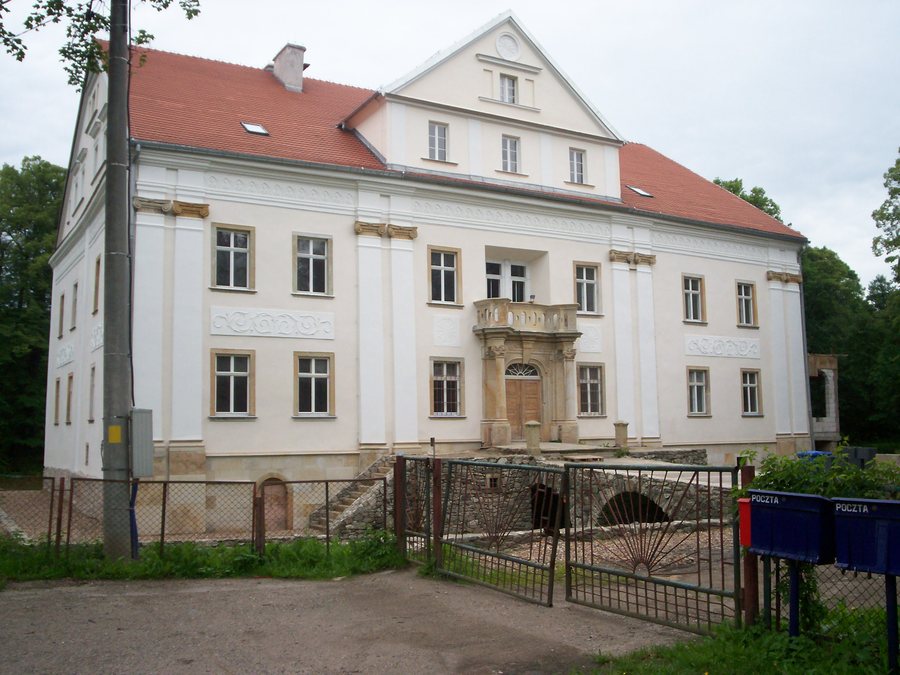
Palace Site and Medieval Traces
The palace in Ciechanowice, Pałac w Ciechanowice, lies on the right bank of the Bóbr. A medieval fortified structure originally stood at this site; only the moat and a stone bridge remain from it. The medieval date applies to the earlier fortification, not to the present-day palace as a whole. This makes it possible to distinguish the historical points of reference: the palace defines the site, while the moat and bridge are the surviving remains of the older structure. Both architectural traces make its history tangible. The reference to the river also helps situate the palace. Visitors interested in historic architectural forms can distinguish the palace site, the former fortification and its surviving elements. The river reference describes the palace’s location; it does not change the fact that the moat and bridge belong to the fortification.
Wzgórze parkowe: History and Recreation Areas
A historic stone slab from the 19th century stands on Wzgórze parkowe. It is a distinct historical reference point, setting it apart from the medieval remains at the palace site. Paths also shape the hill, connecting its individual recreation areas. Information boards and benches are among its other features: the boards help visitors find their way around, while the benches offer a place to sit and pause. For travelers who enjoy walking, the connections between the areas offer a practical way to understand the park hill. The focus here is not solely on a historic object, but also on the layout of the recreation areas. If you are mainly interested in a historical trace with a specific date, the stone slab offers a clear point of reference. If paths and interconnected areas matter more to you, the park’s layout comes to the fore.
Two Distinct Highlights for Planning Your Trip
The historical comparison spans the Middle Ages to the 19th-century stone slab. These two references relate to different features of the place and should not be read as the history of a single building. Ciechanowice therefore offers more than one way to explore the area: you can focus on the architectural past at the palace site or on how paths connect the recreation areas on Wzgórze parkowe. The subjects differ both in their historical period and in what they draw attention to. This can help you decide whether Ciechanowice suits your interests for a trip to Poland. If you are looking for a holiday apartment for a stay in the area, consider which of these highlights appeals most to your travel plans: the medieval traces or the park hill with its connected recreation areas.
Discover more destinations: Lubawka, Leszczyniec, Czarnów, Chełmsko Śląskie, Kamienna Góra, Szarocin, Marciszów.
Back to the broader travel overview: Kamiennogórski.

