
Bienkówka: Hills and Village History
Accommodation in Bienkówka
Bienkówka lies on the slopes of two ranges of hills that surround the village to the north and south. At the same time, the village is situated in the valley of the Kamienna River, which locals call Skorutówka. Hills and valley are therefore equally part of the landscape. If you are choosing a place for your trip to Poland based on its specific natural and cultural features, Bienkówka offers both: wooded heights and buildings, as well as memorials from different periods.
Hills, Forest and Trails
The wooded hills around Bienkówka are predominantly covered with spruce and fir. Beech, juniper and larch grow there in smaller numbers. These differences in composition give the landscape a more precise character than simply describing it as a forest area. The village’s location between the hill ranges to the north and south and the Kamienna valley also helps to convey its character: Bienkówka is shaped by several distinctive landscape features, not just a single viewpoint or hilltop.
A marked blue hiking trail documented in 2016 led north from Bieńkówka towards Lanckorona and south via Koskowa Góra towards Jordanów. The two directions give you specific place names to use for orientation when planning a hike. Another trail-related feature is the educational trail to Babica, which was laid out with markers and information boards. The two trail options differ in this respect: the blue trail indicates directions, while the educational trail to Babica is equipped with information boards. If you are interested in the landscape, you can take both options into account when planning without treating them as a single hike.
Church and Memorial Sites
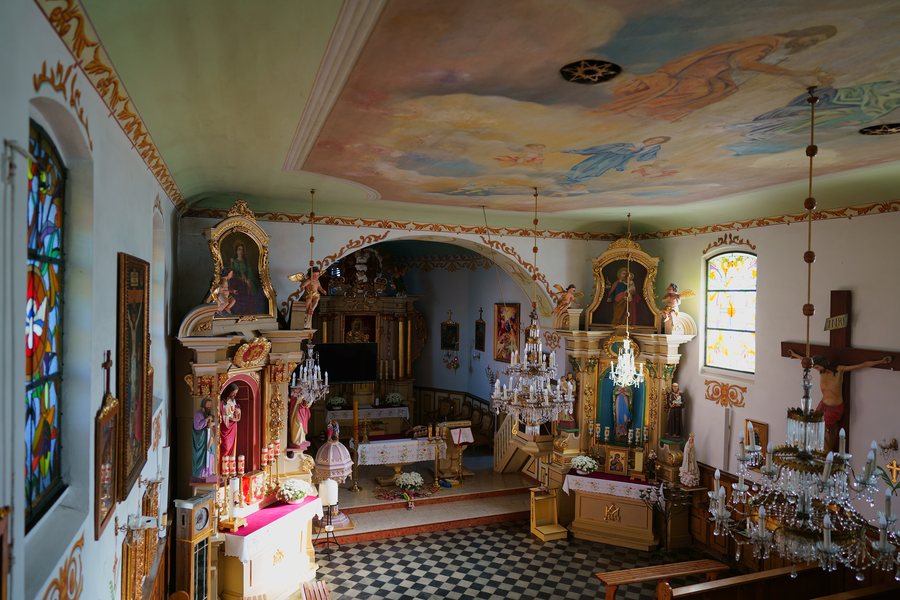
The parish church of the Most Holy Trinity is a stone Baroque building. Its imposing four-sided tower forms an extension of the nave. This architectural form makes the church a notable part of the village’s history. Beside it stands the Oak of Freedom: young people planted it in 1923 to commemorate Poland’s regaining of independence. The church and tree thus stand right next to each other, but tell the story of Bienkówka in different ways—one through its architecture, the other through a specific historical occasion.
Another memorial is the obelisk erected in 2001 in honour of the victims of the Second World War from Bienkówka. The chapel in the village is another historic building: it dates from 1876, is made of stone and has three storeys. Whether it is the Baroque church, the Oak of Freedom, the obelisk or the chapel, the different architectural forms and memorials can be viewed as distinct landmarks in the village’s history. Together, they offer a specific impression of how architecture and remembrance coexist in Bienkówka, without the buildings representing the same period or serving the same purpose.
Considering Bienkówka as a Destination
When choosing a destination, you can weigh up whether you are most interested in the wooded hills, the hiking trails mentioned here or the historic buildings. The hilly landscape and river valley define the geographical setting; the church, chapel and memorials add cultural history. This makes it possible to assess Bienkówka based on specific interests, rather than viewing the village only as a starting point for a general trip to Poland. If you are looking for a holiday apartment, you can consider Bienkówka as a possible destination and compare the landscape and history described here with your travel plans.
Discover More Destinations
Discover more destinations: Krzeszów, Zachełmna, Budzów, Kurów, Białka, Tarnawa Dolna, Maków Podhalański, Sucha Beskidzka.
Back to the main travel overview: Sucha.

