
Discover Mokrzyska: Natural Monument, History and Cycling Route
Accommodation in Mokrzyska
Mokrzyska combines a distinctive natural monument with a historic statue and a documented cycling route. The “Romeo i Julia” poplars give the place its own natural landmark; on Wiślana Street stands a statue with a history dating back to 1865. Cycling route 3 also passes through Mokrzyska. These different points of interest can help you choose the place based on the themes you want to shape your trip to Poland.
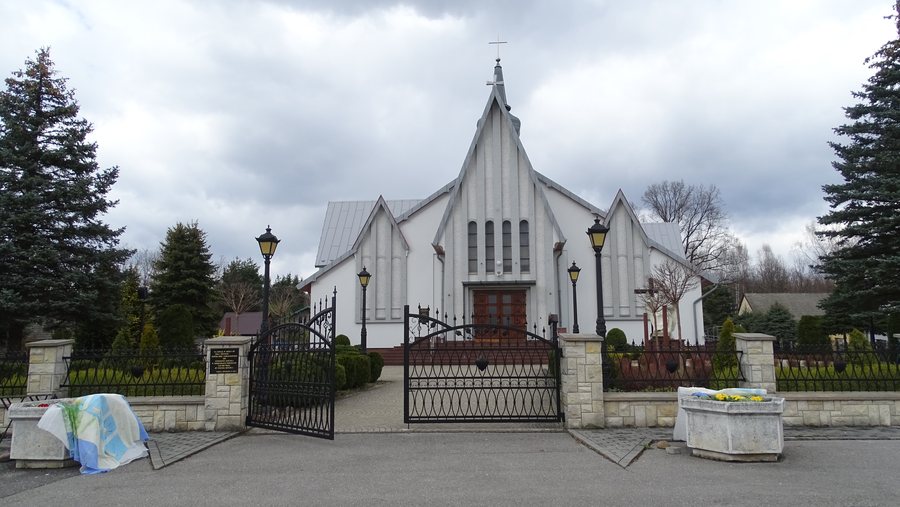 File:Kościół parafialny Najświętszego Serca Pana Jezusa w Mokrzyskach.jpg
Photo: WieKo via Wikimedia Commons, CC BY-SA 4.0
File:Kościół parafialny Najświętszego Serca Pana Jezusa w Mokrzyskach.jpg
Photo: WieKo via Wikimedia Commons, CC BY-SA 4.0
“Romeo i Julia” Natural Monument
At the trees protected as the “Romeo i Julia” natural monument, a smaller second tree grows from the same roots beside the larger one. The larger tree’s trunk measures 385 centimeters in circumference at a height of 130 centimeters. The “Romeo i Julia” tree was granted natural monument status in 2009; the trees are regarded as a tourist attraction in Brzesko County. Here, an unusual growth form stands alongside a specific historical protection decision. The natural monument is also a stop on the discovery route through the Brzesko municipality.
A statue with a story on Wiślana Street
A historic statue of the Virgin Mary with the infant Jesus stands on municipal property on Wiślana Street. The road leads toward Szczurowa. The statue was erected in 1865; its creator was Franciszek Samek of Bochnia, a respected sculptor at the time. The depiction is also described in detail: Mary holds a rosary, while the infant Jesus carries a globe with a cross in front of it. The date, artist, and imagery give this monument a different emphasis from the poplars: here, the focus shifts from a local place to a specific artistic and religious depiction. The two Mokrzyska landmarks thus appeal to different interests, without either replacing the other.
Cycling route 3 through Mokrzyska
Cyclists also have a named point of reference: after passing through Wokowice, cycling route 3 returns through Mokrzyska. The sequence through Wokowice and Mokrzyska can help orient your route planning. Check current route information before setting out.
Brzesko as a wider travel destination
Brzesko’s Town Hall, St. James’s Church, and Jewish cemetery reflect different facets of its cultural heritage. Brzesko Town Hall is an eclectic building with a four-story tower, constructed in 1909–1910. The Church of St. James the Apostle in Brzesko has a historic section dating from the mid-15th century. The Jewish cemetery in Brzesko was entered in the register of monuments in 1992. Together, the three places represent different facets: eclectic architecture, church history, and monument protection.
The routes in the wider Brzesko destination also have distinct profiles. The Szlak wokół Brzeska is a waymarked hiking trail. The Via Regia pilgrimage route runs from Brzesko via Jasień Brzeski and Brzeźnica to Bochnia. This distinction is useful when choosing based on your interests: one name refers to a hiking trail, the other to a pilgrimage route with named places along its course.
Other regional themes include the Regional Museum in Brzesko and the history of the brewery and palace-and-park complex. The museum displays two bourgeois interiors, landscapes, portraits, and local-history memorabilia. The urban and architectural complex of the Brzesko–Okocim Brewery, the buildings surrounding it, and the adjacent Goetz-Okocimski family palace-and-park complex were established from 1845 onward and expanded through the 1930s. In Okocim, an English-style landscape park dating from 1900 surrounds the palace; native and exotic trees and shrubs grow there. The wider Brzesko destination therefore offers everything from museum collections and industrial history to a designed park landscape.
Another landscape and history landmark is Bocheniec, the highest point in the Brzesko area at 394 meters above sea level. The eastern rampart remains of a Wiślan hillfort dating from the turn of the 9th and 10th centuries have been preserved there. They are about four meters high and 18 meters wide at the base. These approximate measurements and the historical context make the rampart remains a specific archaeological point of interest in the wider Brzesko destination.
More destinations
Biesiadki, Czchów, Szczepanów, Łysa Góra, Połom Mały, Iwkowa, Uszew, Brzesko
For the wider travel overview: Brzesko.

