
Czchów: Market Square, Church Art and Nature Trail
Accommodation in Czchów
Czchów’s history is visible in specific places: in the market square, in its sacred architecture and along a nature trail. There are also views of the Dunajec and the Czchów Reservoir. If you are looking for a destination where cultural and natural attractions can be explored side by side, you will find different starting points here for planning your trip.
Market Square: the town’s history in one place
Streets branch off from the corners of the market square, and a church stands at its southeastern corner. As early as the Middle Ages, the Hungarian Route ran across the square. Fairs and other important events were held there at the time—a historical connection that establishes the market square as a central setting in the town’s history.
Some individual details are also worth a closer look: beneath the sculpture of Saint Florian is a Romanesque lion from Czchów’s first church. Six of the 20 original arcaded houses remain on the northern side of the square. They were rebuilt after the great fire of 1947. The lion and the houses each tell a different story about Czchów’s older layers of architecture and history.
The Kazimierz oak, a natural monument, also stands near the market square. Its name commemorates King Casimir the Great. This places a named natural monument alongside the square’s historic architectural features in a compact area; both are among Czchów’s distinctive landmarks.
Church and Gothic frescoes
The Church of the Nativity of the Blessed Virgin Mary is considered the town’s oldest and best-preserved monument of sacred architecture. Its surviving Gothic wall paintings, or frescoes, are particularly distinctive: they are among the oldest and most valuable examples of historical painting in Poland. Czchów can therefore be understood not only through the history of its market square, but also through an important example of sacred art.
If you are interested in architecture and historical painting, the church and market square offer different perspectives: here, the focus is on sacred architectural history and its frescoes; there, on the townscape of streets, arcaded houses and the Romanesque lion. These two themes can be explored separately when learning about Czchów, without following any particular route.
Nature trail and views
Czchów’s nature trail passes through areas of natural interest. Its stops cover features of both living and non-living nature, protected plant species and human activity. The trail has ten stops and takes 90 to 120 minutes to walk. Allow 90 to 120 minutes for the ten stops.
The nature trail climbs a set of stairs to a small tower. From there, you can look out over the surrounding area and the Dunajec gorge. The trail’s natural features and the view from the tower both shape what you see along the way. Please follow the rules: avoid making noise or leaving litter, do not pick plants or disturb animals, and stay on the marked route. Check local guidance on the current route before your visit.
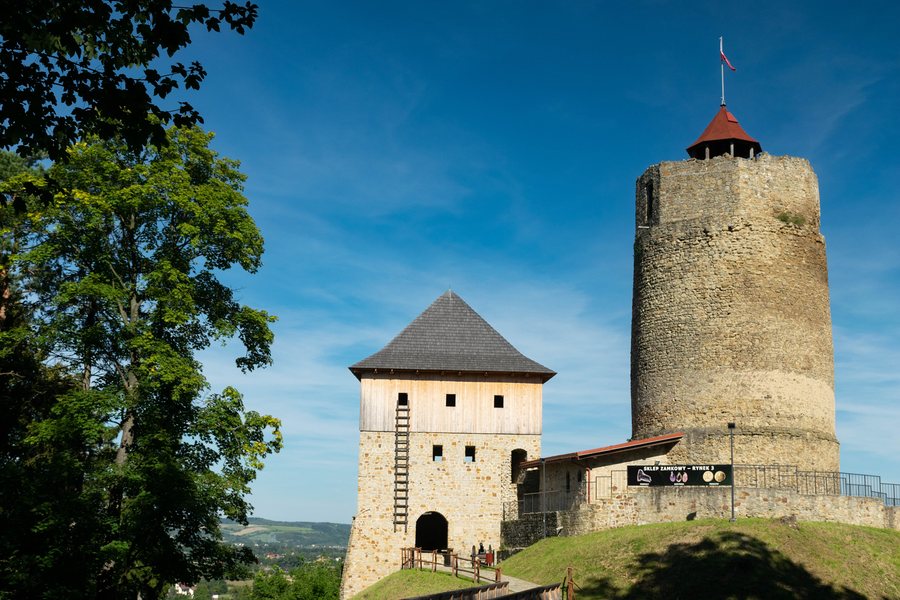
From a viewpoint on the tower in Czchów, you can see across the Czchów Reservoir; in good weather, the ruins of Melsztyn Castle are visible. The ruins of Czchów Castle itself are on Baszta Hill in the southern part of town. For orientation, these are two distinct landmarks: the view over the reservoir, which may include Melsztyn, and the ruins of Czchów on their hill.
You can therefore plan your visit to Czchów around the interests that matter most to your trip: town history and sacred art, natural features along a trail with a set time frame, or views that include Melsztyn only when weather conditions are good. These specific differences can help you decide whether the town fits the priorities of your trip to Poland.
Discover more destinations: Mokrzyska, Iwkowa, Łysa Góra, Szczepanów, Brzesko, Biesiadki, Uszew, Połom Mały
Return to the main travel overview: Brzesko.

