
Discover Brzesko: History and Heritage
Accommodation in Brzesko
Brzesko invites you to discover the city’s history in specific places: at the market square, in historic sacred buildings, and in traces of different architectural periods. The wider Brzesko destination also offers routes and cultural sites that open up further themes for planning your trip.
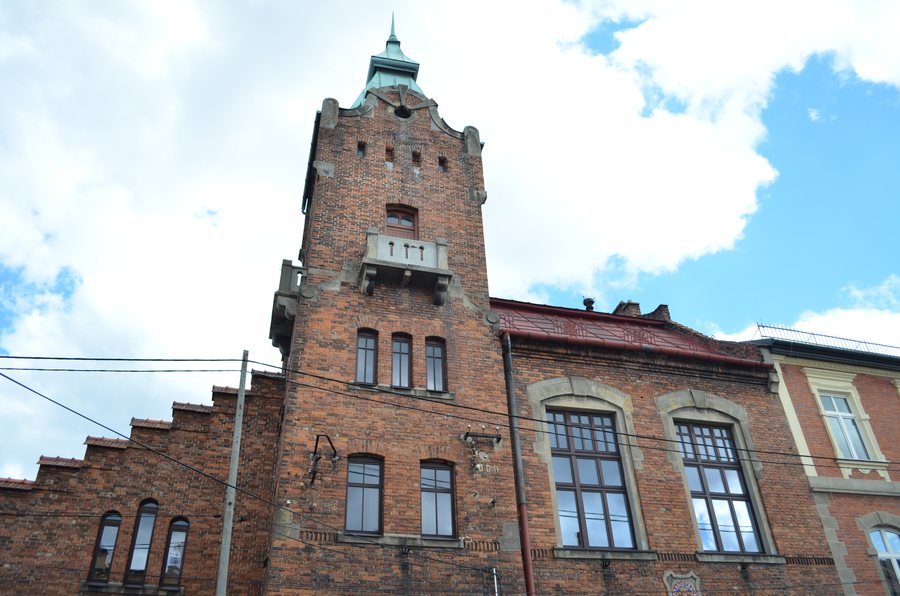 File:Brzesko, ratusz, ob. Miejski Ośrodek Kultury, 1909-1910 8.JPG
Photo: Fmbar22 via Wikimedia Commons, CC BY-SA 3.0 pl
File:Brzesko, ratusz, ob. Miejski Ośrodek Kultury, 1909-1910 8.JPG
Photo: Fmbar22 via Wikimedia Commons, CC BY-SA 3.0 pl
Market Square and City History
A Baroque statue of Saint Florian, erected in 1731, stands in Brzesko’s market square. The city’s residents commissioned it after another city fire. The buildings around the market square also tell the story of the town’s development: they were built after the great fire of 1904 and feature Neo-Renaissance, eclectic, and Art Nouveau elements. The former Brzesko town hall was built in 1909–1910. A mosaic of the griffin from the city coat of arms is on its south façade. Together, these buildings offer different ways to explore local history—from an older monument to architectural traces of the early 20th century.
Sacred Sites and Places of Remembrance
The parish church of Saint James the Apostle in Brzesko has a historic section dating from the mid-15th century. On 6 October 2018, it was elevated to the status of the Sanctuary of Saint James the Apostle on the Via Regia. Dni Jakubowe (St James’ Days) take place in Brzesko every July and attract pilgrims from various parts of Poland. Both the church’s history and a recurring religious tradition are among the subjects you can discover in Brzesko.
Another aspect of the city’s history can be seen at the Jewish cemetery in Brzesko. It was established around 1824; those buried there include Rabbis Arie Leibusz, who died in 1846, and Towi Lipschitz, who died in 1912. The cemetery was entered in the register of monuments in 1992. Its approximate date of establishment and the named individuals buried there give this site its own historical significance within Brzesko’s cultural heritage.
Architecture and Cultural Heritage in the Wider Brzesko Destination
In Okocim, the Goetz family palace was built between 1898 and 1900 to designs by Viennese architects Ferdinand Fellner and Herman Helmer. An English landscape park dating from 1900 surrounds the palace, with native and exotic trees and shrubs growing there. The palace’s architecture and the described variety of vegetation in the park represent two distinct aspects of this cultural heritage.
The wider Brzesko destination also includes the Brzesko–Okocim Brewery complex, its surrounding buildings, and the adjacent Goetz-Okocimski family palace and park complex. The facilities were built starting in 1845 and expanded through the 1930s. The Regional Museum in Brzesko displays two bourgeois interiors, landscapes, portraits, and local-history memorabilia. The range thus extends from architectural and industrial history to insights into bourgeois domestic culture and local history.
Routes and Further Discoveries
In the area around Brzesko, you can explore four circular cycling routes ranging from just over 18 to about 25 kilometres. Audio recordings share information about the places visited, local heritage, and regional traditions. The routes’ different lengths provide a practical basis for choosing a ride; the recordings add historical and cultural themes to the journey. The Szlak wokół Brzeska is also listed as a signposted hiking trail.
The Via Regia pilgrimage route also passes through the wider Brzesko destination, running from Brzesko through Jasień Brzeski and Brzeźnica to Bochnia. At 394 metres above sea level, Bocheniec is the highest point in the Brzesko area. The eastern rampart remains of a hillfort built by the Wiślan at the turn of the 9th and 10th centuries have been preserved there. The rampart remains are about four metres high and 18 metres wide at the base—an archaeological landmark that connects landscape and history.
Stops on the discovery route through the municipality of Brzesko include the Pantheon of Saints in Szczepanów, the “Romeo i Julia” natural monument in Mokrzyska, and the Pavimentum Copernicanum in Brzesko. These stops add further places in the wider destination to the city’s monuments.
More Destinations
Iwkowa, Uszew, Czchów, Łysa Góra, Mokrzyska, Połom Mały, Szczepanów, Biesiadki
Back to the wider travel overview: Brzesko.

