
Biesiadki: Village history and sweeping views
Accommodation in Biesiadki
Biesiadki combines a village layout shaped by history with distinctive wooden buildings and sweeping views from Lipka. This gives you several ways to get to know the village: as a place for a scenic walk, as a forest-clearing and strip-field village, and as a setting for a layered architectural history. St. Matthew’s Church and the cemetery are also specific landmarks that offer insights into the village’s past.
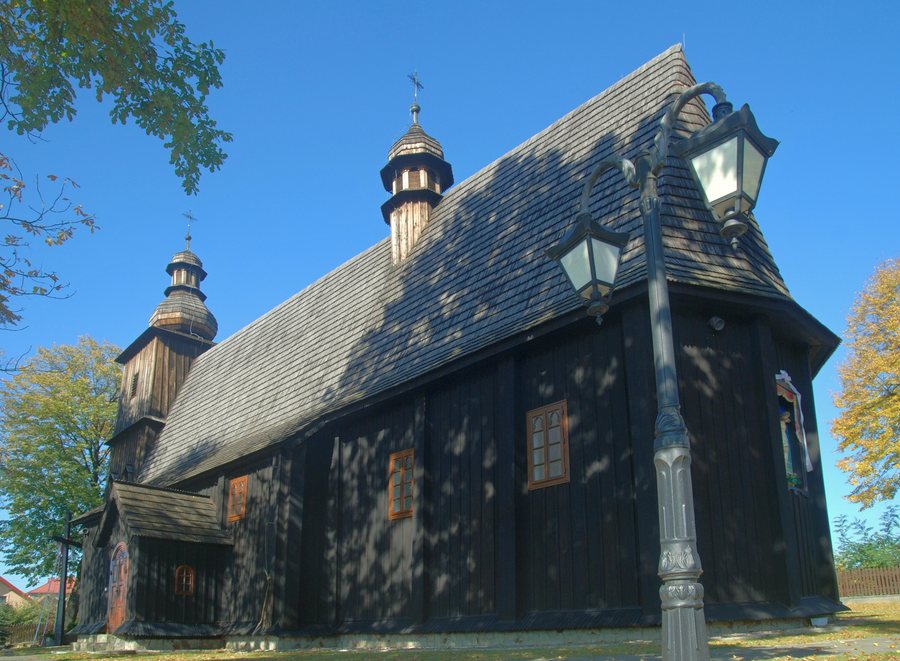 File:Biesiadki, kościół św. Mateusza (HB1).jpg
Photo: Henryk Bielamowicz via Wikimedia Commons, CC BY-SA 4.0
File:Biesiadki, kościół św. Mateusza (HB1).jpg
Photo: Henryk Bielamowicz via Wikimedia Commons, CC BY-SA 4.0
A walk and views from Lipka
As you walk through Biesiadki, plan a longer stop at Lipka. The hamlet lies in the western part of the village. From there, you can see Las Okocimski and the panorama of the Beskid Wyspowy. The nearby municipal area is also visible. On clear days, the Tatra Mountains appear in the background. The view therefore varies with the weather: the Tatras are visible specifically in clear conditions, while the other landscapes mentioned shape the view from Lipka.
If you enjoy combining landscapes with a sense of place, this stop makes a fitting focal point for your walk. Lipka is interesting not only as a viewpoint but also for its location in the west of Biesiadki. The views range from the nearby municipal area to a mountain panorama; it is precisely this shift between the surrounding area and the distant horizon that makes the outlook so varied.
A village shaped by its historic settlement pattern
Biesiadki is classified as a forest-clearing and strip-field village. This classification adds a historical perspective on the village to what you can see in its buildings. Those interested in the development of rural settlements will find another way to explore the area, alongside its architecture and landscape. Together with the wooden buildings arranged in terraces, this shows that Biesiadki is defined not only by individual structures but also by its traditional village layout.
Wooden buildings with distinctive details
The history of the older wooden buildings was marked by a turning point: the great fire of 1920 destroyed most of them. The village’s present-day wooden buildings, arranged in terraces, were built afterwards. The log houses stand out for their boarded walls and gabled roofs. Other details include decoratively carved window frames and painted walls adorned with small carved strip patterns.
These features give you several details to look out for as you explore the village: the shape of the roofs, the design of the walls and the carved elements around the windows and on the strips. The sequence of destruction followed by new construction is part of the village’s history, as is the craftsmanship of the log houses. In Biesiadki, historical change and specific architectural details come together.
Church, cemetery and remembrance
St. Matthew’s Church stands in the centre of the village and is a larch-wood church. Its location and building material give it a clearly identifiable architectural and local context within the village. The parish cemetery also points to Biesiadki’s earlier history: it dates back approximately to the turn of the 18th and 19th centuries.
The grave of an unknown soldier also remains in the cemetery in Biesiadki. The cross erected there to mark the 30th anniversary of the restoration of independence no longer exists. The grave and the vanished cross therefore represent different forms of remembrance: the grave is still there, while the marker from that time has not survived.
If you are looking for a holiday apartment in Biesiadki, these themes offer practical guidance when choosing where to stay: you can decide whether to focus your visit on a walk to Lipka, the wooden architecture or the history of the village.
Discover more destinations: Czchów, Iwkowa, Szczepanów, Brzesko, Połom Mały, Uszew, Łysa Góra, Mokrzyska.
Back to the main travel guide: Brzesko.

.jpg)