
Wielgie: Park, Manor House and Wooden Churches Route
Accommodation in Wielgie
Wielgie can be explored through several distinct features: protected trees in parkland, historic buildings, and the Wooden Churches Route, which connects the village with other stops. Together, they give the place a clear profile for travellers who also consider architectural history and traces of regional culture when choosing where to stay. Each landmark has its own focus and offers clues about the subjects that may be of particular interest to you during your trip to Poland.
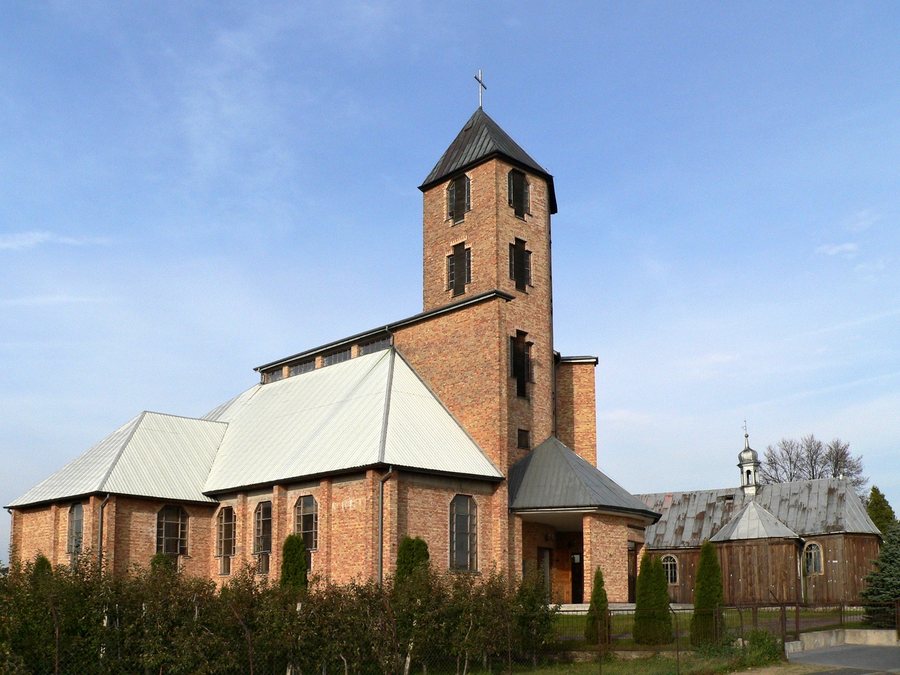 File:Kościół św Wawrzyńca w Wielgiem.jpg
Photo: Przemysław Jahr via Wikimedia Commons, Public domain
File:Kościół św Wawrzyńca w Wielgiem.jpg
Photo: Przemysław Jahr via Wikimedia Commons, Public domain
Natural Monuments in the Parks
A 22-metre-high ash tree with a trunk circumference of 430 centimetres stands in the park in Wielgie. It is protected as a natural monument. These specific measurements give the tree a special place among the area’s natural landmarks: its height and circumference can be appreciated as features in their own right, independently of the historic buildings. A tree is also protected in the manor house and park complex: a red-leaved beech. Together, these two natural monuments add a landscape perspective to the picture of Wielgie. Their stories are also associated with different places: the ash stands in the park in Wielgie, while the beech is in the manor house and park complex.
The Church and Regional Wooden Architecture
The wooden Roman Catholic parish church in Wielgie is dedicated to St. Lawrence (św. Wawrzyńca) and dates from around the middle of the 18th century. It is built using log construction on a stone base. This combination of wood construction and a stone base is a distinctive feature of the church; its approximate date also places it within the architectural history of the area. Wielgie is also connected to a wider series of stops by the Wooden Churches Route, which is useful for planning. This offers travellers interested in cultural history another perspective on the village, without equating the individual church with the route.
The Manor House and Park Complex and Its Buildings
Another point of interest is the manor house and park complex. It includes a manor house built at the initiative of Count Miączyński in the fourth quarter of the 19th century. The complex also includes a mill built around 1900: a plastered brick building with a rectangular floor plan, three storeys, and a gabled roof. The distillery adds its own architectural accent. Built in 1881 from red, partly plastered brick, it consists of several sections of different heights beneath lean-to roofs. The manor house, mill, and distillery thus represent different building types and periods in the history of the complex. Visitors exploring Wielgie through its architectural landmarks will find, alongside the wooden parish church, a historic manor house and park complex with distinctive buildings.
Wielgie on the Wooden Churches Route
The Wooden Churches Route runs from Brzeźno via Ostrowite and Wielgie to Czarne. Wooden churches dating from the 18th century have been preserved along the route. Wielgie is therefore on a route that links several places and has a cultural connection through its surviving wooden churches. For travel planning, this is a different way to understand the village than focusing on a single building or the manor house and park complex: here, the sequence of stops matters. Brzeźno, Ostrowite, Wielgie, and Czarne are the places in the stated order; no walking or driving times are specified.
A Historical Look at Events
A past event is also part of the history of Wielgie Park: on 11 August 2019, it hosted the tenth anniversary two-horse carriage-driving competition. The dated competition offers a glimpse into local traditions, but it is not a current event date. Together with the historic buildings and natural monuments, it adds to the multifaceted picture of Wielgie: architectural history, parkland, and cultural connections can be considered as distinct interests when choosing a destination.
Discover More Places
Lipno, Polichnowo, Głęboczek, Skępe, Glewo, Popowo, Moczadła, Kikół
Go to the main travel overview: Lipno.

