
Koprzywnica between the reservoir and an Easter tradition
Accommodation in Koprzywnica
Koprzywnica brings together a reservoir with a bathing area, a traditional Easter custom, and distinctive church architecture. It can also be included as a stop on a longer circular route. This lets you plan your trip to Poland around different interests: time by the water, a look at living traditions, or a focus on architectural and local history.
Reservoir with two basins
The reservoir consists of the main basin, “DANUSIA,” and the “HANIA” basin. Together, they cover 17 hectares. For those interested in swimming, the town and municipal administration sets up a supervised bathing area for two months each year, staffed by two WOPR lifeguards. The bathing area is available for only two months a year. If it is important to your plans, check the current season dates before your visit.
The reservoir thus brings together two distinct aspects of the town: a clearly named waterside setting and a seasonal bathing area. This can help you decide how much time by the water you would like to include in your stay. If you are planning to swim, the limited season is more important than the fact that the offer returns each year.
Easter tradition and church architecture
One of Koprzywnica’s distinctive traditions is the Bziuki, an Easter custom involving blowing fire. In 2021, the Bziuki were added to Poland’s National List of Intangible Cultural Heritage. The tradition of Bziukania has been associated with the parish church of Matki Boskiej Różańcowej for over 100 years: blowing fire is part of the Resurrection celebration on Holy Saturday. The custom, its occasion, and its connection to the church give Easter in Koprzywnica a distinct local character.
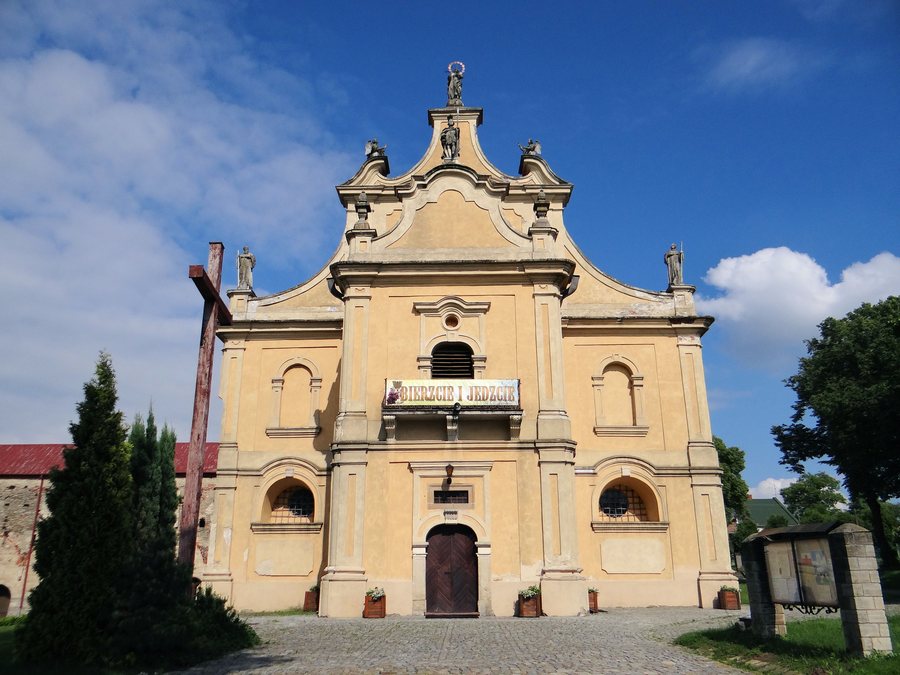
The churches also feature distinctive architectural details. The church of św. Floriana has a fully preserved Romanesque stepped portal with a smooth tympanum. Its prominent Baroque tower resembles an upside-down, bottomless chalice and is known as the “kulawka.” The church also houses the sarcophagus of the Niedrzwicki, created by Santi Gucci in 1581. The portal, tower, and sarcophagus illustrate different aspects of architectural and art history that can be explored separately when learning about the town.
The church of Matki Boskiej Różańcowej stands in the market square. The square is part of the town plan dating from the 13th century, so the church and market square can be viewed together as part of the town’s history. The Koprzywnica monastery also includes the chapter house in its east wing: a spacious room with a stone floor and a stone cross vault resting on two columns. These architectural features describe different places and spaces in Koprzywnica.
Koprzywnica as a stop on a circular route
The 52.5-kilometre Klimontów–Sulisławice–Koprzywnica loop passes through Byszów, Jachimowice, Sośniczany, Błonie, Koprzywnica, Sulisławice, Bukowa, Wiązownica Kolonia, Smerdyna, Jurkowice, Nawodzice, and Szymanowice Dolne before returning to Klimontów. Koprzywnica is at kilometre 18.5. This places the town on a longer, clearly identified route; check the current route conditions locally when planning. Koprzywnica is also on the European Cistercian Route.
You can choose between several different focuses: the seasonal bathing area is for those interested in swimming, the Bziuki connect Koprzywnica with a long-standing Easter tradition, and the churches and chapter house offer specific architectural points of interest. The circular route adds the perspective of a longer journey to these local attractions.
Discover more destinations: Kolonia Gałkowice, Czyżów Szlachecki, Klimontów, Pielaszów, Samborzec, Sandomierz, Ocinek, Konary.
For the broader travel overview: Powiat Sandomierski.

