
Discover Czarnocin
Accommodation in Czarnocin
Czarnocin can be explored through several distinct historical clues: a Baroque statue from 1761, a hill with an interpretation passed down through tradition, and surviving trees from the former manor park. In addition, an early medieval fortified settlement lies in the municipality associated with Czarnocin, near Stradów. These references are not all of the same kind: together, they connect a dated work of art, a traditional explanation, a trace in the landscape, and an early medieval site.
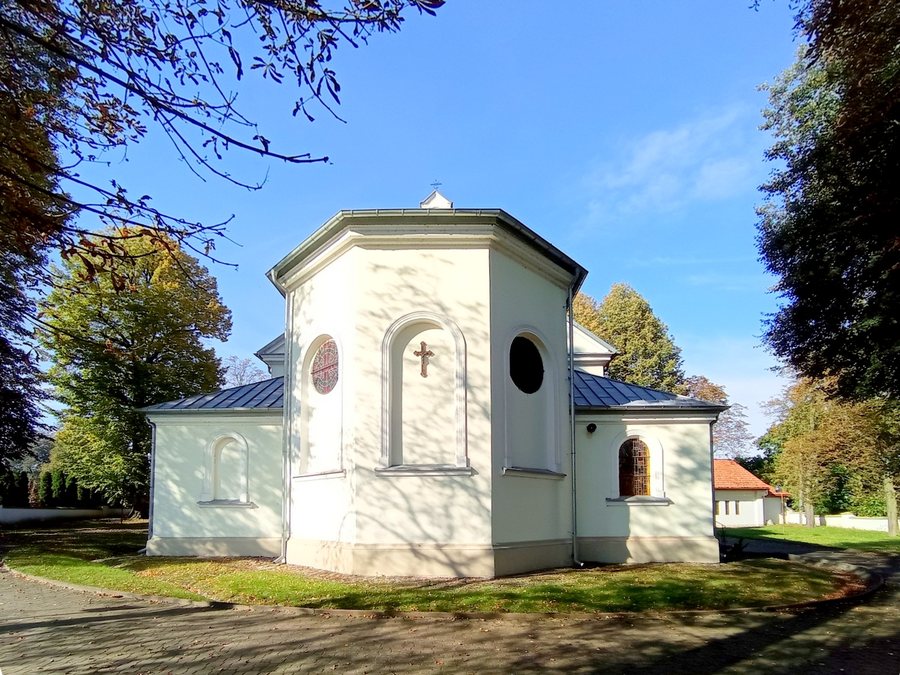
Baroque statue and the tradition surrounding the hill
A Baroque statue of Saint John of Nepomuk, dating from 1761, stands on a hill near the church in Czarnocin. The date provides a specific chronological reference, while “Baroque” identifies its style. The hill near the church is of unknown origin; according to local tradition, it is said to be an Arian grave. This interpretation should be understood as a tradition, not as a confirmed statement about the hill’s origin. The two clues answer different questions: What is the artwork’s date, and what interpretation is associated with the hill?
Traces of the former manor park
Some of the trees from the former manor park have survived in Czarnocin. These trees offer a different historical perspective from the statue and the tradition surrounding the hill. The surviving trees recall the former park and make a trace of the town’s history in the landscape tangible. They should not be regarded as a single, dated work, but as remaining elements of a former park setting. This distinction helps set the local clues apart: an artwork has a precise date, while park trees point to the historical use of the landscape.
The fortified settlement near Stradów
Near Stradów, in the municipality associated with Czarnocin, lies an early medieval fortified settlement that is among the largest in Poland. The site is associated with the municipality; this locational detail distinguishes the municipality from the town of Czarnocin. The term “fortified settlement” refers to a fortified site, making it a different type of historical place from a single statue. Its early medieval dating also places it in a different period from the artwork dated 1761. The reference to its size places the site in a Polish context of comparison.
Different historical perspectives
For trip planning, the differences can be considered in terms of time, tradition, and location. A year such as 1761 is not the same as the name of a historical period; nor is a story about the hill a date. The park offers a different kind of clue: surviving trees rather than a dated artwork or a fortified site. The fortified settlement is in the municipality associated with Czarnocin, near Stradów, while the statue and park trees are located in Czarnocin. For a trip with children, these questions can be a starting point for conversation: Which clue gives a precise date, which belongs to tradition, and which describes a historical period? This makes it possible to explore the town’s history through concrete clues without treating a traditional interpretation as a confirmed origin.
Discover more destinations
Discover more destinations: Opatowiec, Kazimierza Wielka, Kraśniów, Sędziszowice, Odonów
See the higher-level travel overview: Kazimierza.

